Chapter 2
William Henry Harrison and the Shawnee Nation
The Ohio River Valley West to Harrison’s Tomb, Shawnee Lookout, and Indiana
Beginning in the 1780s, White settlers and their armies gradually pushed Indigenous people out of Ohio through a cycle of encroachments, battles, treaties, and betrayals. The history of the Ohio River Valley cannot be diverged from the removal and colonization of Native land.[1]
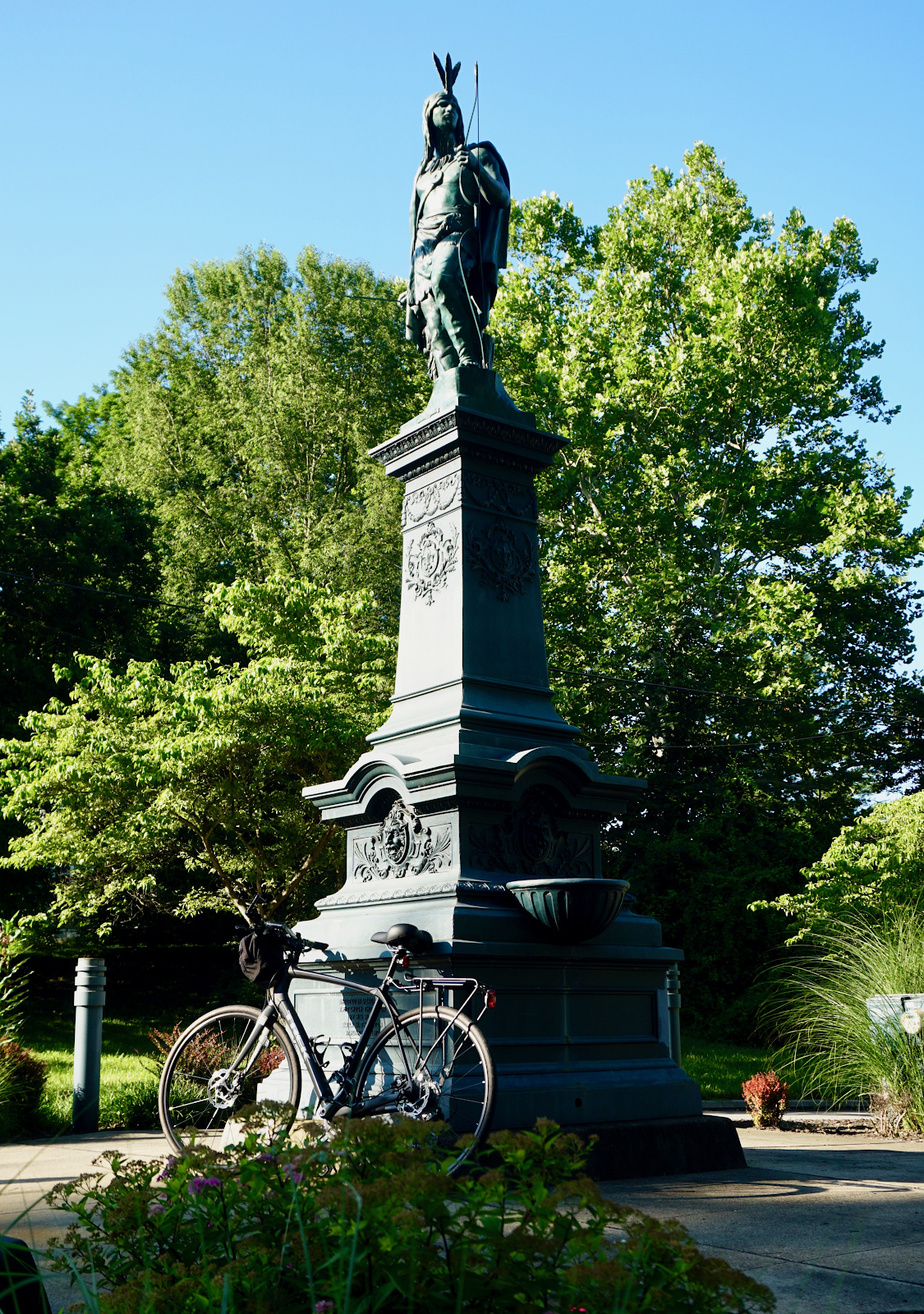
“Tecumseh” statue at Sayler Park
This colonization by U.S. forces was commanded principally by five generals, more or less in succession: George Rogers Clark, Josiah Harmer, Arthur St. Clair, Anthony Wayne, and William Henry Harrison. Harmer and St. Clair both suffered major defeats, and substantial Native resistance continued until 1813, when the great Shawnee leader Tecumseh was defeated and killed in battle by U.S. forces under William Henry Harrison.
After the death of Tecumseh, William Henry Harrison retired to North Bend, Ohio, just west of Cincinnati. Harrison would eventually be elected president, in 1840. But in the meantime, he farmed and was active in local affairs. And he developed a fascination with the people he had helped to displace. Harrison examined the remains of an abandoned Shawnee village at what is now Shawnee Lookout Park, and he published an article about his observations. He had thoroughly misunderstood what he had seen.
The Tour
More detailed information on this route is available on the Bicycling through Paradise community page. We invite you to leave additional information on route updates, detours, and establishments that will be helpful to future cyclists of this route. Here is the general idea.
This is an easy tour, tracing the Ohio River Valley west of Cincinnati. The tour starts at Gilday Recreation Complex in Cincinnati’s Riverside neighborhood and ends in Aurora, Indiana.
The tour is composed of three segments. Total distance is a little over thirty five miles one-way, but each segment is fun to ride independently. Each segment starts and stops in places where you can find parking, food, and bathrooms. For anyone planning a weekend trip, there are overnight accommodations in Lawrenceburg.
The tour runs mostly along quiet roads, with some stretches of dedicated bike lanes, plus a few miles of bike path in the last segment. There is only one serious climb, in the middle segment, and it’s an optional spur. If you don’t take the climb, you won’t see Shawnee Lookout Park, but you’ll see everything else.
Segment 1 goes from Gilday Riverside Park to Cleves (12.5 miles, flat to rolling). We’ll head west on Hillside Avenue to the Victorian neighborhood of Sayler Park, where we’ll see an Adena culture mound and the “Indian Chief” Statue. For generations, people assumed that the statue represented Tecumseh, but the truth is that the statue was bought out of an 1893 ironworks catalog, which only calls it, “#53, Indian Chief,” further evidence of a whitewashing and caricaturing of Native life.[2] We’ll then head west on Highway 50. Approaching North Bend, we’ll head up Miami Avenue until we get to the historical marker describing William Henry Harrison’s role in the development of the Cincinnati and Whitewater Canal. (There, you can tie up your bike and take a very short footpath to see the remains of an old canal tunnel in the hillside.) Just north of here, at Cleves, there is an outstanding restaurant: Nick’s American Café. Try the pie.
Segment 2 goes from Cleves to Lawrenceberg (18.6 miles, including an optional climb into Shawnee Lookout Park). This area is a cyclist’s paradise, with low traffic and beautiful scenery. We’ll head back south on Miami Avenue and then west on Brower Road to the tomb of William Henry Harrison. From there, a very short spur up Cliff Road goes to Harrison’s home site. We’ll continue west on Brower Road. At the entrance to the Duke Energy plant, there’s a small monument to Fort Finney, site of a 1786 treaty between the United States and the Shawnee. We’ll continue on Brower Road/Lawrenceburg Road to the entrance of Shawnee Lookout Park. An optional long climb into the park will take us to the 1795 Micajah Dunn log cabin, a stone schoolhouse built circa 1800, and another small Native American mound. We’ll then retrace our steps, descending back to Lawrenceburg Road and continuing to Highway 50. Approaching Greendale, Indiana, we’ll turn right onto Oberting Road and then left onto Ridge Avenue. We’ll continue on Ridge Avenue, then jog over to enter Lawrenceburg on Walnut Street. Lawrenceburg has places to eat, and several hotels. From Lawrenceburg, we’ll take the Dearborn Bike Trail, which starts on top of the floodwall and continues all the way into Aurora. At Aurora, check out the Hillforest House Museum, built in 1855 for the industrialist Thomas Gaff.
Fort Finney
In 1785 U.S. forces built a small fort, Fort Finney, on the Ohio River, near the mouth of the Great Miami. The fort was built to protect US commissioners who intended to negotiate a treaty with the Shawnee Nation.
The Shawnee had lived in what is now Ohio since the late 1600s. They were an Algonquian-speaking people, skilled at farming and hunting. They’d first encountered White people as fur traders—French, Spanish, and British.[3]
During the Revolutionary War, the Shawnee had allied themselves with the British. The U.S. victory against the British put the Shawnee in a weaker position to negotiate, as White settlers increasingly pushed into Shawnee territory.
At Fort Finney, one of the US commissioners was George Rogers Clark. In Vincennes, Indiana, in 1779, Clark had tomahawked Native American prisoners and had thrown their still-moving bodies into the river. Clark had also led vicious attacks on Shawnee villages in 1780 and 1782. “To excel them in barbarity,” Clark explained, “is the only way to make war upon Indians.”[4]
Another of the commissioners was Richard Butler. Butler had two children by a Shawnee woman, and he was able to speak the Shawnee language. This did not stop him, however, from committing atrocities against the Shawnee.
About 150 Shawnee men and 80 Shawnee women came to meet the US delegation at Fort Finney. After some preliminaries—welcome speeches, smoking peace pipes, dining—the US commissioners demanded that the Shawnee should give up all their land in southern and eastern Ohio. The commissioners vowed that northwestern Ohio would continue to belong to the Shawnee.
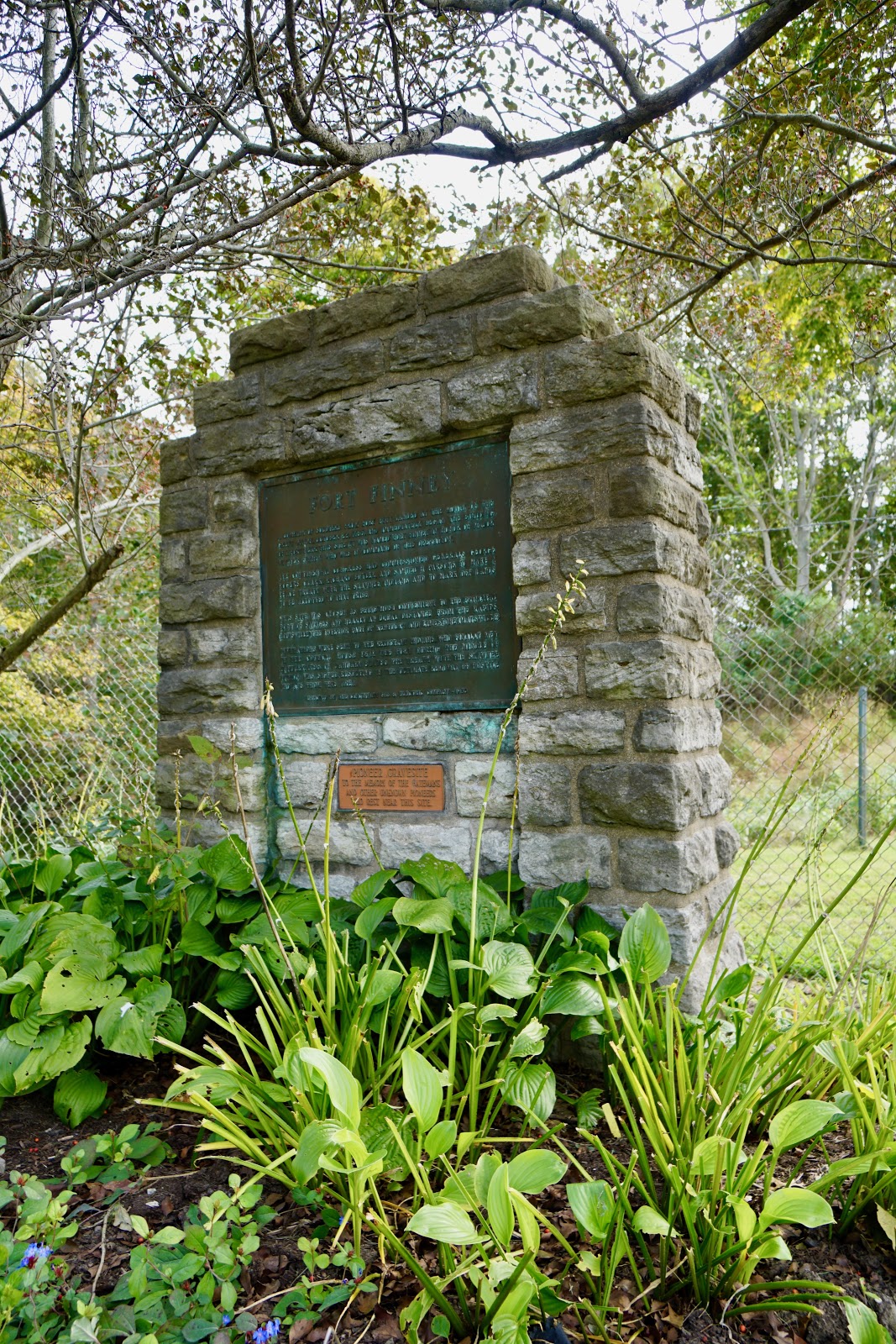
Fort Finney monument
The Shawnee refused the offer. One of their leaders, Kekewepellethe, took out a black wampum belt, symbolizing war, and held it out for the commissioners to take. The commissioners would not take it, so Kekewepellethe laid it on the table. George Rogers Clark took his cane, knocked the wampum belt onto the floor, and ground it under his boot. There were tense discussions, including US threats against the well-being of Shawnee women and children. The Shawnee were forced to accept the terms the U.S. commissioners put forth, and the treaty was signed on January 31, 1786.[5]
After Fort Finney, most Shawnees moved northwest to the Auglaize and Maumee Rivers, near present-day Toledo. White settlers continued encroaching, and the US Army backed the settlers. In 1790 General Josiah Harmer took an expeditionary force of 1,500 US soldiers from Fort Washington in Cincinnati to the Maumee River. Harmer was soundly defeated in battle by Native American forces, led by Shawnee chief Blue Jacket and Miami chief Little Turtle. The following year, U.S. forces under General Arthur St. Clair marched out again from Fort Washington to northwestern Ohio, only to be thrashed once more.[6]
The Rise of William Henry Harrison
In the autumn of 1791, William Henry Harrison was commissioned as an ensign in the US Army. Fortunately for him, he arrived at Fort Washington just a bit too late to join St. Clair’s disastrous expedition. Harrison was there just in time to see what was left of St. Clair’s forces dragging back to the fort.
Harrison was young, aristocratic, and studious. He had no military experience. He was not interested in the carousing that was common at Fort Washington. Ensign Harrison was not immediately popular with the enlisted men.[7]
With St. Clair now discredited, the forces were put under the command of the Revolutionary War hero “Mad” Anthony Wayne. Despite his nickname, Wayne was a methodical and disciplined leader. Wayne took three full years to recruit and train his troops before he marched out to engage the Shawnee again.
This time, the U.S. forces won. In August 1794, at the Battle of Fallen Timbers, near Toledo, Wayne defeated the Shawnee and Delaware under Blue Jacket. William Henry Harrison served as aide-de-camp to Wayne during the battle, and Wayne recognized Harrison in his report.[8]
The following year, White and Native leaders met at Greenville, Ohio, to discuss a new treaty. Anthony Wayne was the lead negotiator, and Harrison was there as well. During the negotiations, Wayne made effective use of spies, bribes, gifts, and threats. When the Treaty of Greenville was finally signed, the Shawnee had relinquished nearly all of their lands in Ohio.[9] (The Shawnee held on to parts of Indiana, and on the Whitewater Canal tour, we’ll ride by a boundary hill marker for the Treaty of Greenville line near Brookville, Indiana.)
Soon afterward, Harrison resigned from the army and accepted a political position as secretary of the Northwest Territory, later becoming governor of the Indiana Territory.[10] Harrison had studied Anthony Wayne’s negotiating tactics carefully, and he would spend the next twenty years whittling away at the remaining Native American lands.
Harrison’s special manipulative tactic was in playing Native tribes against each other. He would, for example, sometimes bribe and bully a tribe into ceding land they didn’t really own, only afterward approaching the actual inhabitants with an agreement that appeared as a fait accompli. During Harrison’s time as governor of Indiana, he negotiated coercive treaties with the Delaware (1803), the Kasakiawa (1803), the Sauk and Fox (1804), and the Miami, Delaware, and Potawatomi (Treaty of Fort Wayne, 1809).[11]
Harrison was also a pro-slavery advocate, and he had at least one enslaved man with him during his time in Indiana. The Northwest Ordinance of 1786 outlawed slavery anywhere in the Northwest Territory, including Indiana and Ohio. But Harrison, manipulated the ordinance, creating a cruel loophole. He believed that this rule was not retroactive, and that slaves who’d been brought into the territory prior to the 1786—and their progeny—could be held in bondage indefinitely.[12]
The Open Door
For all Harrison’s diplomatic clout, even he would have a difficult time dealing with an emerging Shawnee leader named Tecumseh. Tecumseh was a brilliant and charismatic soldier and politician. And Tecumseh had a younger brother, a spiritual leader who claimed prophetic powers.
In 1805 Tecumseh’s brother fell into a trance and had a vision. He saw the Master of Life, who told him that the Native Americans must renounce all of the White men’s ways. They must hold property in common. They must abstain from alcohol and stick to a diet of traditional Native foods—corn, beans, maple sugar, and deer meat—rather than eating White man’s food such as bread. They could keep their guns for self-defense but should hunt with bow and arrow. They should be monogamous and not lead promiscuous lives. They should pray, morning and evening, to the Master of Life. Only in this way could the White intruders be driven from the land.
Up to this time, Tecumseh’s brother had been named Lalawithika, which means “the noise maker.” But now he gave himself a new name: Tenskwatawa, which means “the open door.” The name suggested a possible, alternative future. And after this time, many people called Tenskwatawa something else, too: they called him “the Shawnee Prophet.”[13]
Tenskwatawa began to attract followers. He established a new village, called Prophetstown, at Greenville, in western Ohio. As the movement grew, members of other tribes—Delawares, Potawatomis, Wyandots, Miamis, Sauks, and others—came to hear the Prophet’s teachings. A new Native confederation began to emerge, with Tecumseh standing by as a potential military leader.
William Henry Harrison was alarmed and threatened by the developments at Prophetstown. So Harrison wrote an infantilizing open letter to the Shawnee and their associated tribes:
My Children: My heart is filled with grief, and my eyes are dissolved in tears at the news which has reached me. You have been celebrated for your wisdom above all the tribes of the red people…But who is this pretend prophet who dares to speak in the name of the great Creator?...If he is really a prophet, ask of him to cause the sun to stand still, the moon to alter its course, the rivers to cease to flow, or the dead to rise from their graves. If he does these things, you may believe he has been sent from God.[14]
Harrison must have felt that his letter was a masterstroke. Until, that is, Tenskwatawa responded by correctly predicting the solar eclipse of 1806.
Tenskwatawa named the day and hour at which he would cause darkness to fall across the sun. And at the appointed hour, a full solar eclipse crossed North America in a swath that covered nearly all of the area of the Prophet’s influence. At Prophetstown, the eclipse was 99 percent complete.[15] It is possible that Tenskwatawa had simply gotten his information from a farmer’s almanac. But at the time, few of his followers would have been aware of this possibility. The Prophet’s credibility soared.[16]
In 1810 Harrison and Tecumseh arranged to meet in Vincennes, Indiana, for negotiations. Tecumseh brought four hundred warriors with him. Tecumseh demanded the retraction of treaties that had been forced on the Shawnee. Harrison refused. The two sides parted with no agreement.
Frustrated with diplomacy, Harrison rejoined the army. Leading U.S. forces, he attacked Prophetstown in 1811. Tecumseh was away, and the Native forces were scattered. This came to be known as the Battle of Tippecanoe. Years later, when Harrison was campaigning for president, he and his running mate John Tyler would make much of this victory.[17]
During the War of 1812, the Shawnee allied themselves, once again, with the British, and in 1813 Harrison attacked British and Shawnee forces in Ontario, Canada, in the Battle of the Thames. It was a decisive American victory. Tecumseh was killed in the battle. Tenskwatawa remained alive, but without his elder brother, the Prophet’s power was broken. Shawnee resistance collapsed.[18]
North Bend and Shawnee Lookout
After the death of Tecumseh, William Henry Harrison retired from the army and moved with his family to a farm in North Bend, Ohio. In 1795 Harrison had married Anna Symmes, a daughter of Judge John Cleves Symmes, and Judge Symmes sold Harrison the property. During Harrison’s time in North Bend, he cultivated the land and enlarged the existing log farmhouse.[19]
Harrison was also a major supporter of the construction of a new canal, the Cincinnati-Whitewater, to bring agricultural produce from southern Indiana to markets in Cincinnati. Harrison was a stockholder in the canal company, and he sold land to the company where the route crossed his farm.[20] In 1836 there was a large celebration for the groundbreaking, and many people came from Cincinnati to Harrison’s farm to observe the festivities.[21] (They came on the ill-fated steamboat Moselle—a ship whose story will be told in the chapter “Bicycling Through Paradise”.)
Also during his tenure in North Bend, Harrison spent time examining the remains of a long-abandoned Shawnee village at what is now Shawnee Lookout Park. Shawnee Lookout is a high ridge just north of the Ohio River. It had been occupied by Indigenous peoples for perhaps ten thousand years before the arrival of White settlers. There are dozens of archaeological sites scattered across what is now a thousand-acre park. Excavations have uncovered artifacts from many cultures, including Archaic peoples, the Hopewell, and other Woodland period groups. There are still mounds and other earthworks, but some were more visible in Harrison’s day.
Harrison had previously studied the elaborate earthworks at Circleville and at Newark, Ohio, constructed by the people we now call the Hopewell and Adena. Harrison admitted that these Mound Builders must have had a relatively advanced civilization. He believed that the Circleville earthworks were purely ceremonial and were “never intended for military defences.”[22]
Based on the existence of similar earthworks in Mexico, Harrison also believed that the original Mound Builders had eventually moved south, becoming the people we know as the Aztecs. (This was a standard belief at the time, though one that we now know is wrong.)
Harrison also visited earthworks along the Ohio River, including those at Marietta and at Cincinnati (which no longer exist), and then Shawnee Lookout. Harrison believed that the Ohio River earthworks had been constructed by the same Mound Building people, but later and for a different purpose. These earthworks along the river, Harrison stated, “Have a military character stamped on them which can not be mistaken,” showing a proper appreciation of flank defenses and with bastions placed “precisely as they should be.”[23]
Then Harrison drew a sweeping conclusion. He decided that the original, relatively civilized Mound Builders had been forced out of Ohio by more warlike tribes, after a string of dramatic battles along the Ohio River. Harrison decided that the Mound Builders had evacuated to Mexico only as a last resort.
Who were these warlike tribes who had so violently dispossessed the Mound Builders? Harrison believed it to be the Shawnee, and other current tribes like them. And where had the Mound Builders made their last stand? He assumed at Shawnee Lookout, the southernmost fortified position on the Ohio River. Harrison wrote:
The interest which everyone feels who visits this beautiful and commanding spot, would be greatly heightened if he could persuade himself of the reasonableness of my deductions…That this elevated ridge…once presented a scene of war, and war in its most horrid form…It was here that a feeble band was collected, “remnant of mighty battles fought in vain,” to make a last effort for the country of their birth, the ashes of their ancestors, and the altars of their gods.[24]
Harrison was mostly wrong. It was true, of course, that there had been many previous conflicts between tribes in the Ohio Valley. And it was true that Shawnee Lookout was a naturally defensive location. But Harrison’s vivid and romantic description of a “last battle” was pure fantasy. And there was a reason why this fantasy was attractive. As Robert Silverberg explains in The Mound Builders, “The myth of the Mound Builders was a satisfying one: it was splendid to dream of a lost prehistoric race.” Silverberg continues:
The United States was then busy fighting an undeclared war against the Indians … and as this century-long campaign of genocide proceeded, it may have been comforting to the conquerors to imagine that there had once been another race that these Indians had pushed out the same way. Consciences might ache a bit over the uprooting of the Indians, but not if it could be shown that the Indians, far from being long-established settlers in the land, were themselves mere intruders who had brutally shattered the glorious old Mound Builder civilization.[25]
This is exactly the game that Harrison was playing. And as archaeological excavations continue at Shawnee Lookout, the error and harm of Harrison’s theories becomes increasingly visible.
Archaeology at Shawnee Lookout
Kenneth Tankersley, assistant professor of archaeology at the University of Cincinnati, has conducted fieldwork at Shawnee Lookout, especially with student groups working in the summer of 2009. Preliminary results have been described by Carey Hoffman, who interviewed Tankersley about his work.
Tankersley stated, “This site was originally described by William Henry Harrison as a great military fort. What we’ve discovered this summer is that it is not in any way, shape or form a military fort.” What Harrison thought were wooden “gates” in the “fortifications” turned out to be fired logs and clay bricks that were used as small dams and channels to control the flow of water.
Tankersley and his students sunk drill cores into the earth, which turned out to contain ponded water sediments and clay minerals, “Exactly what you ought to find on an area where water was being captured.” Artesian springs on the hillsides were the source of the water, which was captured and distributed for agriculture.
Tankersley thinks he knows why an irrigation system was needed: the system appears to have been constructed in the five-hundred-year period leading up to CE 500—a period that was unusually cold and dry. Droughts would have been common, and Native Americans would have needed reliable ways to cultivate crops, in order to supplement meat from hunting. According to Tankersley: “It makes you rethink the stereotype for indigenous people. It was thought they were war-like. But they were sophisticated. As the climate was changing, they could adapt. Instead of engaging in warfare, these people were working in harmony.”[26]
Interestingly, some of the irrigation earthworks are carbon dated to a later period, during the time of Shawnee habitation, suggesting that the Shawnee were doing the kind of work previously attributed only to the Hopewell and Adena. Tankersley believes that this argues for some form of cultural continuity between the various groups who have occupied Shawnee Lookout. If Tankersley is right, many previous ideas about relationships between Native American tribes will need to be rethought.[27] Assumptions like those Harrison held are harmful and rest on incredibly problematic stereotypes. Work like Tankersley’s helps to highlight the flaws in such assumptions and contextualizes the truths of the Native peoples in this area.
President Harrison and President Tyler
The last part of Harrison’s story is the part that many have heard before. William Henry Harrison, “Old Tippecanoe,” ran for president in 1840, on the Whig ticket, and he won. At his inauguration, Harrison spoke for an hour and forty-five minutes: the longest inaugural address in US history. He gave that speech outside on a chilly day, caught cold, then contracted pneumonia, and died after thirty-one days in office: the shortest US presidency.
Less familiar is what came next. Harrison’s vice president, John Tyler, was sworn in as the tenth president of the United States. Tyler was a bland functionary, whom no one had expected to become president. “His Accidency,” he was called, by his many detractors.[28]
Tyler was a pro-slavery Southerner, and as president, he became a champion of states’ rights. After his time in Washington, DC, was over, Tyler went home to Virginia. As relations between the North and the South worsened, he advocated for secession. In 1861 he was elected to the Confederate House of Representatives.[29] John Tyler never became a major historical figure. But to the extent that he had any impact at all, it was to hasten the Civil War—a war that would define Ohio and the nation for generations to come.
[1] Colin G. Calloway, The Shawnees and the War for America (New York: Penguin, 2007), xxiv–xxv.
[2] “The Queen’s Crown Jewels: J. Fitzhugh Thornton Memorial,” Queen City Survey, February 18, 2008, http://queencitysurvey.blogspot.com/2008/02/queens-crown-jewels.html.
[3] Charles River Editors, Native American Tribes: The History and Culture of the Shawnee (Ann Arbor, MI: Charles River, n.d.).
[4] Calloway, Shawnees and the War for America, 79-84.
[5] Calloway, 79–84.
[6] Calloway, 85–94.
[7] Robert M. Owens, Mr. Jefferson’s Hammer: William Henry Harrison and the Origins of American Indian Policy (Norman: University of Oklahoma Press, 2007), 16–17.
[8] Owens, Mr. Jefferson’s Hammer, 21–25.
[9] Owens, 31–35.
[10] Owens, 39–50.
[11] Owens, 79–92.
[12] Owens, 68, 72; see also “Former Slave Burned,” Cincinnati Commercial Tribune, October 28, 1899, 2.
[13] Calloway, Shawnees and the War for America, 129–31.
[14] Edward Eggleston and Lillie Eggleston Seelve, Tecumseh and the Shawnee Prophet (New York: Dodd, Mead & Co., 1878), 118–20.
[15] Aymen Ibrahem and Bill Cramer, “Tecumseh and the Eclipse of 1806,” Eclipse-Chasers, April 18, 2015, https://www.eclipse-chasers.com/article/history/tse1806.shtml.
[16] Calloway, Shawnees and the War for America, 134.
[17] Calloway, 139–44.
[18] Calloway, 145–52.
[19] Jeff Suess, “William Henry Harrison’s Presidential Campaign Changed Politics,” Cincinnati.com, May 23, 2015, https://www.cincinnati.com/story/news/2015/05/22/william-henry-harrisons-bid-presidency-changed-campaigns-run/27774087/.
[20] “William Henry Harrison and the Cincinnati & Whitewater Canal,” Historical Marker Database, https://www.hmdb.org/m.asp?m=78769.
[21] Betty Kamuf, “Problems Plagued Canal Projects,” Cincinnati.com, March 24, 2014, https://www.cincinnati.com/story/news/2014/03/24/problems-plagued-canal-projects/6833875/.
[22] William Henry Harrison, A Discourse on the Aborigines of the Ohio Valley (Chicago:Fergus Printing Company, 1883), 10.
[23] Harrison, Discourse on the Aborigines, 10–11.
[24] Harrison, 11.
[25] Robert Silverberg, The Mound Builders (Greenwich, CT: New York Graphic Society, 1970), 48.
[26] Carey Hoffman, “Ancient Connection: Evidence from Summer Digs Points to Shawnee Lookout as Oldest Continuously Occupied Site,” ScienceBlog, September 1, 2009, https://scienceblog.com/24769/ancient-connection-new-evidence-points-to-shawnee-lookout-as-oldest-continuously-occupied-site/.
[27] Hoffman, “Ancient Connection.”
[28] “John Tyler,” History.com, July 9, 2019, https://www.history.com/topics/us-presidents/john-tyler.
[29] “John Tyler.”