Well Then, I’m Joan Henry: Coping, and the Subsequent Threats to Upwardly Mobile Black Women’s Well-Being
Alta Mauro
DOI: 10.34314/issuesspring2020.00007
ABSTRACT
Countless women across the African diaspora are experiencing upward mobility. Research indicates that these women are likely to experience more acute pains of upward mobility relative to their Black male peers or women of other races, given their social position as both women and racial minorities. This article presents an analysis of a qualitative research study designed to explore African American women’s experiences of upward mobility. Specifically, this article centers the psychological and physiological impact of upward mobility on the women in the study, and suggests potential implications for upwardly mobile women across the African diaspora. Care is taken to note that a strategic essentialist approach is employed to conceptualize this heterogeneous group, and to suggest that which might be extrapolated across the community of communities that constitute upwardly mobile Black women across the African Diaspora.
Keywords: Black women; identity; race; social class; upward mobility; code-switching; coping; mental health; emotional health
INTRODUCTION
Thousands of Black women are experiencing upward mobility and achieving many markers of the proverbial American Dream. Existing research has chronicled the oft-experienced strain of upward mobility, conceptualized here as moving up into a higher socioeconomic status than the one in which one was socialized (Simmons 2009:22). Upwardly mobile Black people report experiencing this strain more acutely than those of other races, citing the need to develop a bicultural identity in order to thrive in both their cultures of origin and the dominant culture where they work, attend school, and/or live (21). As a result of social, economic, and political realities, there is an intense pressure for women of color to find acceptance in their work, school, and neighborhood contexts. It is likely that the pressure to develop a bicultural identity is intensified for women, as they do not take the benefit of male privilege with them into new spaces where institutional sexism still impacts women adversely (Doyle and Paludi 1997).
Beal’s (1970) concept of “double jeopardy” captures this intensified pressure, purporting that Black women, in particular, are penalized by both racial and gender inequalities (Beal 1970:90). Collins’s (1990) work proffers that, not only are race and gender locations of oppression, but also that race, class, and gender function as interlocking systems of oppression, each depending on the others in order to perpetuate oppression. Similarly, Crenshaw (1991) warned that attempting to differentiate between or focus on singular systems of oppression often results in neglecting others, at the detriment of the individual who experiences these oppressions simultaneously. In 2006, Berdahl and Moore’s (2006) findings suggest that, despite gains in both racial and gender equality since Beal’s claim in 1970, “[w]omen [still] experienced more sexual harassment than men, minorities experienced more ethnic harassment than Whites, and minority women experienced more harassment overall than majority men, minority men, and majority women” in the workplace (426). Further, Rosette and Livingston (2012) confirm that “[Black women] experience more negative leader perceptions than do leaders with single-subordinate identities (i.e., Black men and White women)” (1).
Black women understand the need to negotiate spaces using new skills, attitudes, and behaviors in order to assimilate into predominantly White middle- and upper-class spaces governed by White values (Simmons 2009). Strauss and Cross (2005) suggest three patterns of such negotiating that impact how Black people are socialized: transactional competence in dealing with racist oppression, engaging other African Americans, and moving through increasingly multicultural communities. In this study, I aimed to understand how Black women conceptualize their own identity as they experience upward mobility, navigating these situations, among others. What is the impact of upward mobility on the ways that Black women understand themselves as individuals? As individuals in the context of their families? In their communities of origin? Situated in new neighborhoods, work environments, and social spaces?
According to Jones (2003), “the potential for upward mobility contributes to a belief that the U.S. class structure is relatively permeable” (804). African American women have a storied and complex history of testing this permeability. Prospects of greater financial stability and social status have been effective motivating factors prompting Black women to pursue professional careers, marriage or partnership with a financially stable mate, and other modes and markers of upward mobility (Higginbotham and Weber 1992). While research has established that social class alone is a significant determinant in one’s life, a review of relevant literature reveals that the intersections of race and gender have a compounded impact on the way that one experiences life in a particular social class or across multiple social classes (Jones 2003:804).
Hill (2012) suggests that the values espoused in the middle- and upper-class spaces to which upwardly mobile Black women gain access may be in conflict with those demonstrated in the working-class communities where they may have been socialized (xviii). Collectivist cultural values are theorized as foundational to Black identity (Carson 2008). It stands to reason, then, that upwardly mobile Black women may struggle to reconcile their identity as they develop individualist, dominant culture behaviors that are valued in these new spaces, resulting—for many—in the development of new, bicultural ways of being that are indicative of middle- and upper-class contexts (Higginbotham and Weber 1992:433).
Identity is a fluid concept shaped by different contexts, and, as some suggest, identity is performed and communicated differently in these different contexts (Sellers et al. 1998). Feminist scholar Judith Butler (1990), in asserting that “male is as male does,” suggests that identity is simply the summation of one’s performance of that identity. Butler contends that “gendered behavior is not the innate expression of a gendered subject, but the result of the performative reiteration of social norms that sediment into the appearance of gendered being … of actions that enact gendered being rather than describe it” (Elliott 2014:379). Similarly, I suggest that being Black cannot be reduced to the simple acting out of a role; however, communicating a Black identity does imply elements of performativity in that it involves both embodying Black cultural values and exhibiting behaviors that communicate those values to others.
A Word on Strategic Essentialism
Black identity is not a wholly describable concept; such racial reductionism fails to acknowledge the differences that exist among Black people and their differing conceptualizations of race and their racial identity. On the contrary, the lived experience of Blackness is subjective and phenomenologically unique in much the same way that members of other cultural groups often have shared experiences that set them apart from nonmembers. I reject the essentialist notion that there are certain characteristics that can be attributed to or used to define every Black person, or that Black women, specifically, are a homogenous, unified group whose claims of Blackness can be policed according to certain characteristics (Phillips 2010). However, for the purposes of this research study, I attempted what Phillips (2010) identified as “a politically necessary shorthand,” which recognizes the otherwise artificially simplified category of “Black women” (2). I employed Spivak’s (1990) sense of strategic essentialism, which invokes a category and suggests members as a collective, while simultaneously criticizing this category as theoretically unviable (Phillips 2010). I suggest that there is a collective understanding held by many African Americans of what it means to be African American, although this understanding is difficult to articulate to those outside the experience of being Black in America.
LITERATURE REVIEW
The following review summarizes literature relevant to the lived experiences of upwardly mobile Black American women and the impact of these experiences on their racial identity. Research findings on the development of Black racial identity are outlined first, followed by a summary of literature related to racial socialization. In summarizing these two areas of literature, I have endeavored to situate the process of enculturation, or socialization, as girls in poor or working-class Black families, in contrast to the process of acculturation, or exposure to new values and learning new behaviors, as women in either middle- or upper-middle class White spaces (Berry 2003:18). Differentiating between the enculturating contexts of family, home, and other familiar institutions and the acculturating context of new spaces governed by dominant values was fundamental to the study, as these are the locations where racial identity is shaped and reshaped, and where racial identity intersects with one’s other identities in critical ways (Sellers et al. 1998). I then explore research that distinguishes between the particularly gendered socialization of girls by race, followed by a review of select literature about experiences at the intersection of gender and race. I conclude with a review of literature on class and upward mobility among African Americans.
Racial Identity Development among African Americans
Constantine et al. (1998) offer an extensive review of Black identity development theories, beginning with those that emerged in the psychological literature of the 1970s (95). Original theories attempted to define Black identity, and to establish that an over identification with White culture and Whiteness is inimical to a Black person’s health (Helms, as quoted in Constantine et al. 1998:95). These theories assert that a Black person achieves a healthy racial identity by progressing from degrading or negative thoughts about themselves, other Black people, and Black culture (alongside idealized regard for White people and White culture) to internalized positive sentiment about themselves, other Black people, and other racial minorities (95). Constantine et al. (1998) organize these early theories into two categories: “mainstream approaches,” regularly referred to as Nigrescence models, and “underground approaches,” which have drawn less attention than mainstream models (96). Nigrescence models are marked by a focus on the cognitive, affective, and behavioral processes by which a Black person develops a positive racial identity; the latter models rest on the notion that positive Black influences may support a Black person’s development of a healthy self-concept without having internalized a negative view of one’s racial self (Constantine et al. 1998:96).
Cross’s (1971, 1991) identity development models are among the most popular (96). The psychologists’ original Model of Nigrescence outlines the stages through which Black people progress as they develop a Black racial identity (96). Cross’s 1991 model reflects a deep influence of the literature on Black racial identity published after his original (1971) model, most notably, regarding the concept of race salience in Black identity (Vandiver et al. 2001:167). The first stage, pre-encounter, is marked by an internalization of Eurocentric values and beliefs that White people are superior to Black people. With the encounter stage, Black people experience a realization of the existence of race and an arousal of a racial consciousness, which brings about a shift from anti-Black to pro-Black sentiments. During the third stage, immersion-emersion, Black people immerse themselves in Black culture and distance themselves from Whiteness and the penchant from Eurocentricity. Internalization is marked by a relevant, positive Black identity and a reconciliation of the ideological conflicts that are a hallmark of both the pre-encounter and encounter stages. The goals of internalization-commitment (Cross 1971) are identifying and disrupting systems of oppression, primarily for Black people, but for other people of color as well (96). Helms (1990) updated Cross’s original model, suggesting that the stages be considered “ego-statuses” to acknowledge a more fluid identity development process (97).
Vandiver et al. (2001) updated Cross’s 1991 model, introducing the concept of miseducation, by which one could hold negative stereotypes about Black people without hating oneself (197). More importantly, the authors introduce three independent ideologies: Black nationalist, biculturalist, and multiculturalist (Vandiver et al. 2001:180). Critical among the Vandiver et al. findings was the emergence of an internalized bicultural identity, which is marked by an acceptance of being both Black and American (Vandiver et al. 2001:182); similarly, an acceptance of one’s multiple identities was also a criterion for this research study, as participants needed to identify as both Black and American. After a comprehensive research study, Phinney et al. (2001) concluded that developing a bicultural identity served to facilitate minority student success in school settings, in particular (Phinney, et al, as cited in Phalet, Andriessen, and Lens 2004:67). These authors do not extrapolate this finding beyond academic settings; however, existing research has cited the development of a bicultural identity as one coping strategy employed by upwardly mobile people of color across various settings (Simmons 2009).
Racial Socialization in African American Families
Sociologists describe socialization as the process of acquiring the knowledge, skills, attitudes, and behaviors deemed appropriate by those of a particular cultural group (Thomas and Speight 1999). By extension, racial socialization is defined as the process of transmitting values, perspectives, or other information about one’s racial group to children (Hughes et al. 2006:748). Further, racial socialization supports a child’s development of a positive racial identity, which will support them in coping with racism and being both physically and emotionally healthy, despite living in an oppressive environment (Thomas and Speight 1999). Families are considered “primary institutions,” as they are typically the first and most crucial influencers on a child’s identity (Hill 2012:xix). The influence of family in determining one’s racial identity is especially high and has therefore been the focus of extensive research across the social sciences.
Taylor, Chatters, Tucker, and Lewis (1990) found that parents of color prepare their children for the realities of living in the United States as a racial/ethnic minority. Additional studies have shown that the majority of African American parents actively engage their children in conversation or activity related to their Black identity, as opposed to avoiding Black identity in conversation with their children (Burton et al. 2010). Of primary concern to African American parents who socialize their children racially is striking a balance between preparing children to accept the realities of racial discrimination but still strive to achieve, without using race or racism as an excuse for failure.
Hill asserts that social class is essential in the shaping of family life by asserting that “[s]ocial class is arguably the most powerful predictor of many aspects of social life, including the structure and viability of families” (2012:xiii). The author posits that, “although social inequalities based on gender, race, and ethnicity continue to exist and, obviously, affect families, social class position cuts across these dimensions of inequality in its ability to explain family life” (Hill 2012:xviii). Hill incorporates Collins (1990) and Zinn and Dill (1996), acknowledging the impact of race and gender intersecting with class to influence both the socialization of children and life throughout adulthood (Hill 2012:43). Hill’s (2012) findings related to the socializing power of families and the effects of family social class establishes a foundation for the exploration of the racial socialization of children by gender.
Gender Socialization by Race
The past three decades have seen an increase in the research on the racial socialization of African Americans and other racial/ethnic minority groups (Burton et al. 2010). Whereas early research on Black families claimed that gender alone was not a significant factor in the socialization of children, more recent studies of Black families have found that when the impact of social class is considered, gender has a considerable impact on the ways that Black children are socialized (Hill 1999). Hill (2012) found that low-income Black parents were more likely than middle-class White parents to tailor their parenting based on their child’s gender; most often, middle-class White parents’ intention was not to teach their children explicitly gendered behaviors (86).
Thomas and Speight’s (1999) study aimed to fill the subsequent gaps in what is known about the process of racial socialization among Blacks. The authors cite the importance of a positive racial identity, evidenced by psychological adaptation and increased self-esteem, among other characteristics (Thomas and Speight 1999:153). They incorporate Boykin and Toms’s (1985) categorization of Black families according to the type of racial socializing messages they transmitted to children: mainstream, indicating families who socialize children in accordance with Eurocentric values and beliefs, despite exhibiting Afrocentric values; minority socializing, representing a degree of passivity in accepting oppressive and racist beliefs; and Black cultural, indicating families where Afrocentric values (i.e., communalism, spirituality, harmony, etc.) are transmitted.
The authors cite existing research that suggests that parents with more formal education and higher social class may be more inclined to engage in the racial socialization of their children (Barnes 1991). They note, however, that socialization occurs in both implicit (e.g., attending and/or participating in race-related civic engagements) and explicit (e.g., discussions on the importance of racial pride) ways. In contrast to Hill’s (1999) suggestion, the authors confirm that the racial socialization messages used by Black parents do actually differ according to gender (Thomas and Speight 1999:152). For example, in a cited study, “teenage boys reported receiving messages on racial barriers and egalitarianism, whereas girls reported receiving messages on racial pride” (Bowman and Howard 1985).
Thomas and Speight (1999) explored racial identity and attitudes about socialization among African American parents. Ninety-six percent of participants in their study reported that teaching their children about racial issues was important, citing “the reality and presence of racism, the importance of being prepared to cope with racism, and the need to function appropriately in a racist society” (Thomas and Speight 1999:160). An analysis of respondent data gleaned from the 104 participants revealed that girls received more messages stressing the importance of achievement and racial pride than boys did; girls were also given messages warning against premarital sex, while boys were not (Thomas and Speight 1999:162). Finally, many participants highlighted the importance of instilling their daughters with a sense of acceptance of their own physical beauty, to combat their consumption of mainstream beauty standards (Thomas and Speight 1999:165).
Hill (1999) opens a review of gender socialization in Black families with a quote taken from Collins’s (1987) study exploring the conceptualization of motherhood in Black culture:
Black daughters are raised to expect to work, to strive for an education so they can support themselves, and to anticipate carrying heavy responsibilities in their families and communities because their skills are essential for their own survival as well as for the survival of those whom they will eventually be responsible.
Hill considers this possibility that Black girls are expected to “do it all” while Black boys are held to lesser expectations (1990:122). The author clarifies that very few studies have been dedicated to the ways that Black boys are socialized but that some have suggested that daughters are expected to be more competent and self-reliant than are boys (McAdoo 1988).
Socialization under nontraditional gender norms is considered by some to benefit Black women in the long run because it encourages the development of traditionally male characteristics (such as independence, competitiveness, and self-confidence) (Hill 1999:123). Hill cites Carr and Mednick (1988) who found that girls who were socialized in more “male” ways were more motivated toward achievement than girls who were not. It may be that being socialized under such divergent expectations leads to the pronounced differences in lived experience which Black men and women often report. These differences in expectations and subsequent lived experiences may also contribute to strained relations between Black men and women and, eventually, the distance that upwardly mobile Black women feel exists between them and Black men, of whom less is (culturally) expected (Ucko 1994).
Black Women at the Intersection of Race and Gender
Higginbotham (1993) calls special attention to the plight of Black women in America and the nearly impossible burden of having to choose either race or gender as their primary identity. In describing the women’s movement in the twentieth-century Black Baptist church, the author praises Black women for carving out “…what Patricia Hill Collins calls ‘a safe space’ for self-determination [in the church] … [where Black women] expressed themselves openly and without fear of reprisal” (186). One might imagine that this creation of safe space was quite difficult to do, given the nature of the rhetoric around race that demonized Black people, in general, as subhuman and Black women, in particular, as overly sexual, immoral objects. This “rhetoric of violence” and other attempts to overdetermine Black identity meant that Black women had to overcome great obstacles in establishing their social worth (de Lauretis, as quoted in Higginbotham 1993:189). Higginbotham notes that “[t]he discursive effort of self-representation, of re-figuring themselves individually and collectively, was an immense one—stretching well beyond the limited context of their relationship [with others]” (186).
More than just establishing themselves as worthy of respect, Higginbotham suggests that Black women had to “[assert] agency in the construction and representation of themselves as new subjectivities—as Americans as well as blacks and women” (1993:186). This implies that they were not widely recognized as being all three simultaneously, or that Black women had to choose a sole identity marker, as opposed to embodying the intersections of their many identities. The author notes the urgency of positioning both race and gender themes within the context of their American identity (Higginbotham 1993:186).
This urgency to oppose structural and symbolic representations of the all-encompassing White supremacy that denied them their full existence propelled Black women to adopt goals and strategies to reform the system of race relations in America (Higginbotham 1993:186). The resulting goals and strategies privileged respectability, compelling Black people to protect their self-esteem and self-determination, despite their income or social status (Higginbotham 1993:191). Although well-intentioned, this “politics of respectability” did as much to reify hegemonic White American values as it did to disrupt the subordination of Black women based on race and gender (Higginbotham 1993:187). Its deliberate deference to hegemonic values as “proper” can be said to have been problematic, in that it reinforced highly negative stereotypes and cast those Black Americans who resisted such a way of being as unworthy (Higginbotham 1993:194). It can be argued that these damaging stereotypes still exist today and impact the way that Black women are viewed in America.
Although the plight of Black Americans is markedly different now than 100 years ago when the Black women’s movement in the Black Baptist church was at its zenith, the struggle to establish a positive self-concept despite racism and gender oppression persists. Crenshaw (1989) notes “the tendency to treat race and gender as mutually exclusive categories of experience and analysis” (139). The author goes on to suggest that “[b]ecause the intersectional experience is greater than the sum of racism and sexism, any analysis that does not take intersectionality into account cannot sufficiently address the particular manner in which Black women are subordinated” (Crenshaw 1989:140). Because this tendency prevails, so does the need for critical research that considers the intersectionality of one’s various social identities.
Narayan (1988) supports the notion that those living under oppression may achieve a more critical perspective on their situation than do others but cautions against the romanticizing of this “epistemic privilege,” as oppression does not necessitate this enlightened position (312). This is especially critical in the consideration of upwardly mobile Black women, who inhabit oppressed positions in multiple contexts and may experience the complexity of intersecting identities in everyday life. As Narayan suggests, “the relationship between the [multiple] contexts the individual inhabits may not be simple or straightforward” (1988:316). They may find themselves attempting to dichotomize their racial, gendered, and class-based identities, and employing different frameworks to make sense of seemingly different lived experiences.
Upward Mobility among African Americans
In 1978, sociologist William Julius Wilson warned that Black America was becoming polarized into two extremes: an economically depressed lower class and an affluent, formally educated middle class (Wilson 1978). Wilson’s suggestion that class had replaced race as the primary predictor of African Americans’ life chances has been both challenged and corroborated (Niemonen 2002). As what Robinson (2011) calls “the splintering of Black America” into four distinct Black Americas continues, significant differences between Black subgroups and the ways that they experience life have become more apparent (5). What was once considered a monolithic group composed of members who experienced life in America in similarly predictable ways, Black America is now understood as a richly diverse community of communities. As such, there is increasing room for a “multidimensional conceptualization of [B]lack identity,” marked by differentiation in identity, behavior, and responses to stress (among other factors) (Demo and Hughes 1990:364).
Bettie (2002) suggests that race/ethnicity and class are often conflated or reduced to each other. It is especially critical for the purposes of this study to acknowledge “how both social forces operate independently yet intersect” (Bettie 2002:38). Jones (2003) suggests that the “two ways of conceptualizing the relationship between class and ethnicity [are] class as a dimension of ethnicity and class as distinct from ethnicity” (808). The author goes on to demonstrate a race-based alignment with these conceptualizations; while the experiences of poor and working-class Whites reveal that Whiteness does not guarantee class-based privilege, members of historically marginalized racial groups who are disproportionately represented in lower social classes may develop their class and race identities in tandem (Jones 2003:811). This finding underscores other research on the intersections of race and class, and affirms the notion that upwardly mobile Black women, having conceptualized their notions of a racialized self during their socialization in working- or middle-class locations, experience those identities as inextricably linked, more so than a White woman from a similar background and newly situated in a higher social class. This raises questions about how upwardly mobile Black women reconceptualize their racial identities as they shift into new class identities and take on new, adaptive behaviors in these new social class locations. This linkage may also impact the stress that Black women experience when their identities and subsequent sense of belonging among members of their home communities is challenged. If race is as influenced by class as Bettie (2002) suggests, what then remains of the upwardly mobile Black woman’s sense of Blackness when her attitudes, behaviors, and/or ways of being shift, in accordance with her new social class standing? Is a new, collective identity emerging among this upwardly mobile group? If so, does the influence of one’s upward mobility serve to differentiate this new identity from versions of Black cultural identity influenced by poor, working- or middle-class status? Most critically for this article, given what has historically been regarded as a collectivist nature of Black communities, how do upwardly mobile Black women understand and deal with the fallout of this differentiation, be it real or perceived?
Detriments of Upward Mobility
Multiple researchers have established the benefits of upward mobility (Simmons 2009; Jones 2003). Despite these benefits, many social scientists contend that there are considerable detriments to such movement, citing acute and chronic stress and stress-related illness as a primary physical detriment (Hudson, Neighbors, Geronimus, and Jackson 2015) and social isolation among peers in new communities (Jones 2003). Further, upward mobility has not delivered Black people from marginalization, discrimination, or racism (Marsh et al. 2007:7).
In particular, Black women have reported feelings of conflicting (social) class loyalties. Overall describes this sense as being “nowhere at home” as a result of upward mobility (Overall 1995:209). They may find it difficult to maintain strong ties to their families and communities of origin while developing new ties in higher social classes. Even previously supportive family members may appear disinterested in their experiences or dismissive of their struggles with new issues (Higginbotham and Weber 1992:416). Deterioration in family and friend relationships is likely to cause internal conflict for the upwardly mobile Black woman, as much of her identity may rest on her sense of self in relation to others (Higginbotham and Weber 1992:418). A woman socialized in a collectivist Black community may find herself feeling alone in more individualist, White spaces where independence and detached attitudes prevail.
Bettie (2002) suggests that class is a characteristic most often ascribed to men. The author notes that “[w]omen make the stage as class subjects … when they represent consumption and leisure, not work” (Bettie 2002:34). This notion may help to explain the isolation from family that many upwardly mobile Black women experience; given the importance Black families place on socializing girls toward hard work and performance, it may be possible that, as these women come to represent consumption and leisure instead of work, they appear less familiar to members of their families who are not upwardly mobile. What are the potential implications for a Black woman’s identity in the context of her family unit as such a shift takes place?
Jones (2003) expounds on the notion of social isolation that upwardly mobile Black women may experience, stating that “marginalization happens within, not only between, racial groups” (814). Upwardly mobile Black women are likely to internalize this marginalization from other Blacks in lower class status groups as a punishment for distancing themselves from Black communities or spaces in exchange for acceptance in the academy, their workplace, and/or their upper-class residential community. These feelings of detachment from home communities are often compounded by those of isolation from colleagues, neighbors, or other peers in new social circles, as people generally associate with others of the same class and race (Gilbert and Kahl 1982).
This connects to James’s John Henryism Hypothesis (1994), where he purports that the effects of prolonged high-effort coping, or the “determined, hopeful manner” with which many low-income Blacks deal with stress, had negative physical health effects (James 1994:160, emphasis in original). Low-income Blacks whose coping measures proved successful were more likely to persist; as a result of their persistence, they were more likely to develop adverse health conditions, including exhaustion, hypertension, and elevated heart rate (James 1994). Although the research sample in the original 1983 study was completely male, James (1994) asserts that the implications of John Henryism hold for Black women. James’s findings have been foundational in the research weighing the health cost associated with upward mobility against economic and social returns. In short, while there are definitely stressors related to living in poverty or among the working class that many would hope to escape, research has established that managing the high levels of stress associated with achieving upward mobility is detrimental to physical health (Miller, Yu, Chen, and Brody 2015).
METHODS
The study sample included ten self-identified African American women who identify as upwardly mobile. The primary methods of data collection were in-depth interviews, focus groups, limited email exchanges during member checks, and field notes. In-depth semi-structured interviews were the primary method of data collection, during which time respondents were encouraged to speak in their own words. This also allowed the researcher the flexibility to respond to what participants offered. Sample interview questions and prompts included:
- Talk to me about your childhood. I am especially interested in anything you remember related to your race, class, and gender.
- Follow-up questions about social class when it was not mentioned:
- What would you say your social class status was growing up? Tell me why you would describe it as such.
- What did your parents do, professionally?
- What kind of home did you have? How would you describe it?
- What kind of neighborhood did you live in? How do you remember it?
- Follow-up questions about race if it was not mentioned:
- Do you remember when you became aware of your race? If so, can you share how you came to be aware?
- What can you tell me about the experience(s) that led you to know your race?
- Suppose you and I were to go back in time and visit your childhood home together. What would I see happening or hear being said related to race? What implicit messages about race might I miss?
Each of the 10 participants were first engaged in an individual 60- to 90-minute interview and then engaged them in four 90-minute focus groups (two in-person focus groups with three participants each, and one in-person focus group with two participants). An attempt was made to host a virtual focus group with the remaining two participants, but scheduling was prohibitive. Follow-up with each participant via either email, Skype, or phone interviews ensured that their responses to themes from focus groups were captured.
Conversations during both initial interviews and focus groups were audio-recorded and later transcribed to ensure accuracy of the data captured. Additionally, I observed respondents’ word choice, tone and intonation, and nonverbal communication (including, but not limited to: body language, hand gestures, facial expressions, shifts in posture, etc.) during both interviews and focus groups. I also noted the nature of contact between participants, further allowing me to contextualize and make sense of their responses. I intentionally sought clarification regarding the meaning of respondents’ nonverbal communication, as not to take for granted that I understood their ways of connecting and communicating simply because I also identify as an upwardly mobile Black woman and am part of the in-group.
I captured field notes during and immediately following interaction with participants. I noted my observations of each participant and those nuances that could not have been captured by the audio recording. I tried to note nonverbal behavior, overlaps in the conversation, and what felt like shifts in the emotional atmosphere; it was also important to note my initial understandings and explanations of these phenomena. Further, I noted lingering questions to pose during follow-up interviews, or issues broached that would require further study. Revisiting these field notes allowed me to bracket my unchecked assumptions, identifying emergent themes more objectively than had they been overly influenced by said assumptions.
Themes from the data reflect that participants were expected to be hyper-performers, and were thus positioned for success in predominantly White spaces where different cultural value systems prevailed. Pivoting between these differing value systems proved psychologically and physiologically taxing. This supports James’s John Henryism Hypothesis (1994) where he posits that the effects of prolonged high-effort coping had negative physical health effects. Those who exhibited successful coping measures were more likely to persist despite challenges; a result of their persistence was the increased likelihood of developing adverse health conditions, including hypertension, elevated heart rate, and exhaustion (James 1994).
PARTICIPANTS
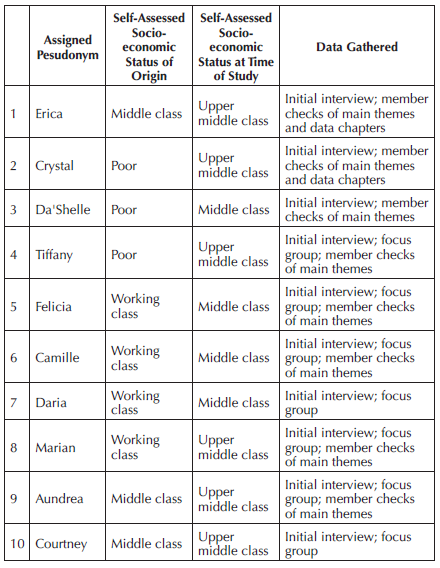
Each of the 10 respondents self-identified as African American (and were identified as Black or African American by the women who referred them, when applicable). One participant, Aundrea, referred to herself as “Black,” “African American,” and “biracial” interchangeably during both the individual interview and the focus group in which she participated. On occasion, Aundrea framed personal challenges associated with upward mobility as especially pernicious because of her blackness; at others, she noted taking advantage of her racial ambiguity, particularly as it allowed her to enter into advantageous relationships with White people. At another point, she expressed the limits of this access, stating that certain spaces were still too White, and thus off limits to her.
Another participant, Erica, indicated meeting the criteria for eligibility before we met for the initial interview. However, during this conversation, she indicated that she “did not grow up broke—at least to [her] knowledge. We were comfortable.” Similarly, Courtney indicated that while she would consider herself upwardly mobile, her parents were middle class.
Table 1. Respondent Data Gathered
FINDINGS
While participants were happy to have escaped stressors related to living in poverty or among the working class, their experiences confirmed research indicating that managing the high levels of stress most commonly associated with achieving upward mobility also poses a threat to sound physical and emotional health (Miller, Yu, Chen, and Brody 2015). After hearing the story of John Henry, a steel driver who emerged victorious in a race against a steam engine, only to die of heart failure with hammer in hand, Crystal remarked “Well, then ... I’m Joan Henry. A dead Joan Henry!” suggesting that both her ability to succeed professionally and inability to cope physically or physiologically mirrored John Henry’s, tragically. Beyond acknowledging the potential physical and physiological impact of carrying such stress, participants were also acutely aware of the tremendous psychological stresses of upward mobility, suggesting that said stress may be a new normal for upwardly mobile Black women. Participants recognized their need to attend to their physical, mental, and emotional necessities, but reported feelings of isolation in dealing with stressors that members of their families did not face and, therefore, could not understand fully. Further, the women in the study felt ill-equipped to cope with these threats to psychological and physiological well-being, acknowledging a dearth of culturally sensitive models from which to draw inspiration. Themes among research findings included: code-switching and engaging multiple versions of themselves across various contexts perpetually; seeking refuge from the pressures of upward mobility; and experiencing loneliness or isolation from family, friends, or former communities as a result of being upwardly mobile.
The Perpetual Pivot of Code-Switching
The women in the study talked at length about the code-switching that they had come to master in order to be successful across the various contexts in which they found themselves. This was thematic across individual interviews and focus groups where participants affirmed each other’s stories of switching in and out of certain registers. Most could describe a practice of surveying the environment and those around them in order to decide what was appropriate or inappropriate to do. Beyond this behavioral code-switching, the majority of participants also indicated that they regularly embodied different personas, or sides of themselves, in order to meet the needs around them.
Crystal described the need to shift:
In the position that [upwardly mobile Black women] are in, the issue is … we have to … change up for different people in different groups.... I mean, you don’t want to say it but—I mean, it’s there. I’m not a White woman, I can’t just be me wherever I go. I have to adjust to these people over here, then I have to come over here and adjust [to] these people over here. Then [at] family functions I adjust to [the] people over there…. It’s challenging but that’s our life every day.
Neither Crystal nor Felicia or Camille suggested that this need to pivot was unique to them solely because they are upwardly mobile. They did, however, suggest that the perpetual nature of the need was indicative of their experience as Black women operating between classes. This makes sense, as upward mobility has required that they move back and forth between predominantly poor- and working-class spaces where many of their families still live and middle- to upper-middle class spaces where they often work. According to participants, they likely move between these spaces and engage across these cultural lines more often than those who are not upwardly mobile and who are therefore less likely to engage with people outside of their communities.
Felicia noted that one difficult factor of the adjustments is that they often need to happen abruptly; one may not always be able to shift smoothly or at a comfortable pace. “Sometimes you gotta change quick—no choice” she noted. “Like a pivot?” I suggested. “Just like a pivot!” she exclaimed. This sentiment resonated with other members of the focus group. Crystal began mimicking the physical pivot many would recognize from basketball to illustrate the point, her body coming to an abrupt stop as she switched directions. “See, we be out here looking like—” as she demonstrated the jerky movements back and forth. “With the pivot. But not just the pivot—the perpetual pivot” as she continued to shake off her imaginary opponent. While participants all laughed immensely at Crystal’s imitation of a basketball player, they acknowledged how aptly the notion of a perpetual pivot was in illustrating the constant challenge of code-switching that participants had described.
Several participants acknowledged that this pivoting was not wholly synonymous with coping in these stressful situations. On the contrary, this code-switching was, in itself, physically and emotionally taxing. Two elements made it taxing: the sheer frequency with which they had to switch into new roles, and the potential threat that this accessing different personas posed to their authenticity.
When Erica was asked what it was like to balance her need to embody so many sides of herself, she indicated complex feelings, saying “[o]n the one hand, I’m glad I can switch. On the other, it makes me worry that I’m not real in either situation, and not being real is not an option.” I interjected, asking “You’re not being a real what in either situation?” to which she replied, “I’m being real but I guess—I’m being less authentically Black. That threat takes its toll, emotionally. You start to doubt where your center is,” she lamented.
At several other points during our first interview, Erica went on to speak of the fear that fluidity threatened to compromise her authenticity as a Black woman, and thus, challenged her sense of overall balance. Other participants did so as well, expressing varying degrees of concern regarding the shifts they have experienced in their identities. While being flexible in their behavior had been critical to their success, it also incited the fear that they must also be becoming “less authentically Black,” as Erica quantified it.
Storm Closets
The women in this study spoke to the importance of relief from the stresses of upward mobility. They described seeking refuge from both psychological and emotional “storms” associated with perpetual pivoting and engaging multiple versions of themselves from setting to setting. Each of them recognized the need to disengage from school, work, family, and, in some instances, active social lives, in order to rest and recharge. Erica alluded to the need to take a break from even herself, having grown exhausted in her attempt to make balancing the many sides of herself look easy:
There’s some mental and emotional stuff that needs to be dealt with. [I] need to figure out where all this comes from and deal with it because it’s unhealthy. But we are so good! We are powerhouses! Just being that—showing no vulnerabilities, until a tornado comes [and] then you realize you aren’t as solid as you thought you were.
Interviewer: And then, if your home has a storm closet, and you close the shutters, you can walk away [from a storm] with minimal damage. But having minimal damage just reinforces the powerhouse mentality.
Erica: If a tornado [would] blow the whole thing down then you’d be forced to look at the other house and be like, “that tornado blew the whole house down. Alright I need to reevaluate my strategy.” But then, what happens? Like, the little sapling in the front yard gets blown down, [or] maybe one of the shutters that was really just for decoration anyway, those blow off. That’s external. I don’t need all that stuff, so then it’s just like, well if that house can stand then I’ll have to be able to withstand too. So these are seemingly like, it’s reinforcing the expectation of you being able to withstand whatever—anything.
According to Erica, the storm closet is not a physical location; it is a metaphor for a place of refuge from outside pressures—those associated with being a Black woman, being upwardly mobile, and the intersection of the two. In her experience, the purpose of the storm closet is a place of respite from the mental and emotional toil of her life. Like the physical “powerhouse” that she described, Erica believed that, as a Black woman, she is expected to weather considerable storms without showing signs of damage.
When asked if the beautiful home she shared with her fiancé and son had an actual storm closet, ironically, it did not. “My house doesn’t have a storm closet. My powerhouse does, though! I just [haven’t] been in it in a minute…. Even though I should’ve.” Erica went on to say that she did not have solid coping strategies in place. She offered that she could “cope, if it can even be called that,” for a short amount of time but that she was better at adapting to situations and internalizing the stress than she was actually coping. In a word, she had incorporated the perpetual pivot into her way of being, and felt more confident that she could shift her persona and/or behavior than apply effective coping strategies in the midst of challenges related to upward mobility.
Other participants described their efforts to seek refuge from the stresses of upward mobility. Crystal shared how physical exercise provided an opportunity for her to blow off steam, maintain her physical health, and center herself emotionally. She stressed the importance of being an active agent in one’s physiological health, especially since many people may not be aware of the impact that high stress has on the body. Tiffany described her commitment to yoga and healthy eating as critical in ensuring that her physical body could withstand the physiological pressures she experienced as a result of her high-stress job. While these two spoke about exercise as a specific coping strategy, the balance of participants referenced more intrinsic methods of maintaining sanity, peace, and/or balance, but were much less confident that those intrinsic methods were being effective.
The women in this study understood the importance of experiencing relief from the myriad stresses of upward mobility. They attempted to escape both psychological and emotional “storms” associated with the perpetual pivoting they felt pressured to maintain. All of them recognized the need to disengage from the sources of pressure, namely work and family who did not understand their experiences, in order to rest and recalibrate. One participant suggested that the pressure of pivoting so often was further impacted by her need to make it look easy. This stress weighs so heavily on her that she often needs a break from herself. Most participants suggested that this type of periodic disconnection was important but, given the myriad responsibilities that they were not always able to attempt it, let alone achieve it. They were adamant that some form of coping with the stress of upward mobility was essential to their sense of well-being, and many of them had cultivated specific practices or strategies.
Thick Love, and the Lack Thereof: Upwardly Mobile Black Women’s Experiences of Loneliness
The women in the study spoke at length about the impact of having internalized others’ high expectations of them at an early age. Beyond meeting and exceeding these expectations and subsequently experiencing upward mobility, many participants reported other byproducts of their hyper-performance: isolation and loneliness. From responding to pressures to work well beyond standard work hours and simply not being available to socialize with others, to feeling alienated from family members with whom they felt they could not share their successes or challenges, to being unable to maintain romantic relationships, most women in the study had experienced some degree of loneliness since becoming upwardly mobile. The tremendous hurt of not being able to share their accomplishments with the family members who originally encouraged them toward such success weighed heavily on some women in the study. In some cases, the very friends and family who had encouraged the women toward such success were absent or silent when the participants achieved their goals. Some family members felt distant from the women’s achievements and were therefore unwilling to celebrate their milestones. The women spoke of pining for well-wishers, community, and authentic connection, and not trusting that they still had it with the people they had once valued most. They had aimed for goals that their family inspired but felt that they could not share the extent to which they had achieved them.
DISCUSSION
Participants in the study offered insight into the challenges they face as upwardly mobile Black women. They asserted that the frequency with which they had to code-switch in order to adapt to shifting contexts; their need for refuge from the stress of upward mobility; and the sense of isolation they experienced as a result of being upwardly mobile were accepted as part of a new normal, given the magnitude of their everyday stress. While participants agreed that self-care was important, mental or emotional health in this new normal was largely relegated to reframing stressors as opportunities to serve their communities. Because this is an underanalyzed demographic, this article may provide critical insight for those who seek to deepen their understanding of relevant psychological and physiological challenges to the well-being of this expanding segment of the global middle class, although further study is warranted.
The New Normal: Reframing Expectations of Themselves
Data from this study indicate that upwardly mobile Black women believe that the “ungodly amount of stress and pressure [that they are] so used to living with” is their “new normal.” Aundrea first used the term during the second focus group, in response to my query about how they understand and then manage the stress that upwardly mobile Black women feel as a result of racism, sexism, classism, clashes in values, and isolation or disconnection from (some) meaningful friends, among other factors. Interestingly, women in the focus group would respond to another participant’s suggestion that that they “don’t even call it stress anymore,” as dealing with these pressures is such a routine part of their lives.
Aundrea responded, “I think I have moved on.” The conversation began to overlap significantly, as both Tiffany and Marian chimed in with agreement repeatedly. Aundrea went on to say, “I think, at some point, you just get over it. I have gotten over it. I am over—”
Marian: So I am like Aundrea, I think. I just moved on and like... whatever.
Aundrea: ’Cause if we harp on it, we won’t get past it.
Tiffany: You will be stuck in it. You get accustomed to it, and you become numb to it.
Marian: You’re desensitized to [it]. Yeah, it’s nothing. It’s not a factor.
Aundrea: And if it is, you just nip it in the bud that moment and on that day, and just keep moving.
I had suggested that the stress that these women dealt with on a regular basis was abnormal. They responded by agreeing, but only somewhat. More importantly, they seemed to suggest that, as both a fellow upwardly mobile Black woman and a researcher, I should simply move on. According to this group, there was more risk involved in confronting the stress and potentially getting stuck there than there was in ignoring it.
In the following focus group, I explained how one participant had introduced the “new normal” concept and asked if this notion resonated with others. It did, and the topic elicited a significant amount of discussion. Additionally, of those participants who responded to my attempts at member checks or offered other feedback, this theme was most often commented and agreed upon. Camille, a participant in the second focus group, challenged the notion that these levels of hyper-stress were new to Black women at all. She commented that Black women are used like mules. This reminded me of the oft-quoted line from Nanny, a character in Zora Neale Hurston’s (1937) Their Eyes were Watching God: “De nigger woman is de mule uh de world so fur as Ah can see.” Camille’s suggestion that upwardly mobile Black women were not unique in dealing with stress, and that doing so was “just a part of the Black woman’s experience,” resonated with Crystal and Felicia, who were participating in the same focus group. When asked if it were possible that upward mobility impacted the amount of stress that they experienced as Black women, though, all three women conceded, although Camille was slow to do so initially.
Similarly, participants in the third focus group affirmed that upward mobility served to impact their experiences as Black women. Daria attempted to explain her and other participants’ hesitation at being singled out from other Black women for the amount of pressure they are under. Perhaps this was a recognition that their mothers, sisters, cousins, friends, sorority sisters, and other women peers who were also Black, also experienced a tremendous amount of stress by virtue of living in a patriarchal society where people are often segregated or discriminated against on the basis of race, skin color, or lack of wealth.
There may be other reasons why the women initially insisted that their stresses were not different from other Black women’s. It may be possible that suggesting that their stress was still less daunting than other Black women’s stress may have been a strategy to signal a continued sense of belonging among Black women in general. Many participants found it difficult to maintain connections to the communities of Black people where they had once belonged. These attempts to not appear different from other Black women made sense, given participants’ claims that they still subscribed to communal Black values, desired to belong to Black communities, and desired relationships with other Black women.
I could not help but remark about the matter-of-fact way in which the women described the tremendous amounts of stress in their lives. Marian suggested that while the stresses she and other participants were describing were not new, what was new was the role each of them were being allowed to play because they are upwardly mobile. During a focus group, she said that those participants who are mothers
are probably carrying their husbands and children. Others are carrying themselves and, sometimes, their extended families, whole community uplift efforts. Not new. What is new, though, is that many of us are also leading companies, corporations, you know? As Black women have not always done—have not always been able to do, or allowed to do, we could certainly always do it! And now, we have access to the best education, wealth, creature comforts… a higher quality of life.
Aundrea and Tiffany agreed with Marian’s suggestion that stress related to “carrying” families and community efforts felt similar to the burdens that other Black women had long bore. Again, participants’ attempts to highlight how they were no different than other Black women were evident.
Some women in the study remembered being called “White,” or otherwise scrutinized for White behaviors, during childhood or adolescence. Many spoke in detail about the strategies they used to overcompensate for others’ perceptions that they were “less Black” than others. It follows, then, that they may continue to employ strategies that make them identifiable as “more Black” well into adulthood. Again, insisting that certain differences between them and other Black women (who are likely not criticized for acting White) are insignificant was but one strategy for invoking feelings of sameness and belonging among themselves and other Black people. This also makes sense, given how some participants suggested that the perpetual pivoting they are compelled to do may lead others to believe that they are not authentic in either space. They must be authentically Black if they were experiencing what other Black women felt.
Marian recognized that Black women’s roles leading companies, corporations, and other efforts beyond their families and immediate communities was relatively new. What resonated was the way that Marian framed these stressors as burdens that she was allowed to carry. She went on to note that her ability to be an influential “decision maker where it counts [was] a big deal.” Being able to take on these burdens in the service of others was considered a privilege. Tiffany interjected how actively quantifying the impact she has had in her community helps her to frame her stress differently. She said, “[W]hen I look at what I’ve been able to do, I see it as a blessing—despite the unbelievable stress.” It was a privilege to bear these burdens, because they were understood as pushing their communities forward. Accepting their stressors, and recognizing the privilege that came with the increased wealth and status that added to those stressors, served to make the stressors more acceptable.
It is understandable that serving others could deliver a return on one’s sense of satisfaction with themselves. However, the way that participants seemed to frame their responses to stress in this way was simplistic. Marian interrupted my attempt to problematize this notion. She said, rather bluntly, “Opportunity, not obligation. It is an opportunity.” It was a privilege to be in a position to serve members of her community, as opposed to being on the receiving end. This may have been another attempt at reframing the same stress that relegated the strong Black woman back to her historical role of serving others and bearing others’ burdens alone—and liking it. Questions to consider, if this is true: What is the impact of such high expectations being considered both their duty and their reward? What is the impact of gathering all of these stressors and sources of pain, professional frustration, and personal disappointment and insisting that they fit together under the banner of “opportunity”?
Tiffany then chimed in to say, “What else am I gonna say?! Right? How else am I gonna think about it? It is an opportunity—” at which point I asked, “So you’re just fooling yourself by calling it an opportunity [instead of an obligation]?” She, Aundrea, and Marian all laughed as she replied, “No, no one is fooled! No one. What good would it do me to call it an obligation though, or to be mad about it?!? I have to do these things. I have to.”
Upon reflection, many questions linger: Is it possible that participants have internalized societal demands on them, so much that they are convinced that they represent their life’s mission? How might this impact the ways that upwardly mobile Black women raise Black daughters, or otherwise influence young Black girls? How might this impact the ways that they set out to raise Black sons? What might they socialize Black boys to expect of Black women, either as siblings, family members, peers, friends, or romantic partners? How might their relationships with biracial children unfold, given the differences in how they might experience the intersections of race, class (and perhaps ethnicity), and gender?
It is difficult to accept what participants seem to understand as “the new normal.” One cannot fully reject their acceptance, given the “double jeopardy” that upwardly mobile Black women are likely to face (Beal 1970:90). However, they seemed to have settled into their overdetermined identities more so than I am willing to do on my own volition. I am reminded of yet another Zora Neale Hurston quote: “If you are silent about your pain, they will kill you and say you enjoyed it.” It is difficult to consider that the women were being silent about their pain, even though we were together in a place where it would have been safe to vocalize it.
Mental Health in the New Normal
Participants in each focus group were challenged on the “new normal” concept in order to determine the degree to which they accepted that what they were describing was “normal.” I asked the women if it were possible that accepting this way of being was unhealthy; that they were compartmentalizing or otherwise blocking out significant aspects of their lives so that they could persist/survive/etc. Each of the ten participants agreed that this was a possibility, but not one mentioned having considered it before the suggestion.
The nonchalant way that they describe these stressors suggests an attempt to disown the stress without disconnecting from the stressors. They seemed to believe that the magnitude of their stressors could be lessened if they simply reframed them as opportunities. Participants suggested that accepting their new normal was the result of bearing so much stress. Is it possible, though, that accepting that they should experience so much stress in fact contributes to their stress? Further research could establish if one way to cope with the pressure is to accept that the intersection of one's identities may mean that one will likely experience both race- and/or job-related pressures.
I asked participants if it were possible that their self-prescribed ability to deal with the “ungodly amount of stress” that they anticipated may preclude them from getting the professional and emotional support that they need. Many agreed that this was a possibility. Accepting that being an upwardly mobile Black woman automatically means that one will have to endure more stress than is manageable for the average person, may also suggest that one cannot resist these stressors. Can a lifetime of hyper-performance and self-sufficiency leave one unable to seek or accept support from others?
In addition to feeling that they are not allowed to resist stress, accepting that so much stress is normal may preclude upwardly mobile Black women from seeking professional support to identify appropriate coping strategies or to otherwise attend to their mental and emotional health. Throughout the data-gathering and writing process, the trope of the strong Black woman, and how it serves to limit who and how Black women can be in our social imagination, reemerged (Beauboeuf-Lafontant 2009). Research has already established that Black women understand that they are expected to be hyper-performing and strong. Participants’ stories support this.
Beyond affirming research on the trope of the strong Black woman, participants’ stories suggest that they may be unable to resist this trope for reasons that may be unique to them. It is possible that upwardly mobile Black women are not able to resist these harmful tropes because they must demonstrate the same herculean strength that other Black women do, lest they be ridiculed as “less Black.” Being Black women, their identity has been overdetermined for them. If a Black woman’s overdetermined identity includes stress at the intersections of race and gender, who are these women to escape said stress? If a Black woman’s overdetermined identity is demonstrated by exhibiting certain collectivist values, which do not include drawing attention to the individual, how are these women to focus inward, even if in attempts to identify coping and healing strategies for themselves?
Of the ten participants, two mentioned having sought counseling. Both of these women shared that they did so after feeling overwhelmed but did not disclose further. Further research on compartmentalization may reveal the impact of upwardly mobile Black women disassociating from this stress, and offer implications for how they can acknowledge and face their stress, and identify strategies to cope with them.
CONCLUSION
This study focused on the complexity of Black women’s experiences of being upwardly mobile. Their experience of not fitting in fully among family or friends or in middle- and upper-middle-class spaces left them feeling “nowhere at home,” as Overall explained of upwardly mobile women at the intersections of race, class, and ethnicity (Overall 1995:209). In response to this othering, they felt compelled to pivot, or code-switch, in order to achieve success, sometimes engaging different personas in different contexts. While this has resulted in their professional success, the frequency with which they have had to pivot has brought great stress and varying degrees of isolation from their families and communities. Understandably, the women reported seeking refuge from the exhaustion of such frequent code-switching. Many suggested that, while they were able to do it, they believed that such perpetual pivoting posed a threat to their sense of self; they worried that, the more they pivoted between Black and White cultural spaces, in particular, the less they were able to be authentic in either. When asked to describe how they preserve a stable sense of self, given the pressures they feel to embody such different sides of themselves, participants spoke to the importance of cultivating relationships to combat loneliness and physiological damage.
Implications for Further Research
The women in the study suggested that the tremendous amount of stress they were under is a new normal for upwardly mobile Black women. As a researcher, I am left wondering if it is possible that accepting their fate in this way simultaneously supported participants’ ability to cope and decreased their ability to envision and/or create coping strategies? In other words, is it possible that accepting identity-based stress prepares one to deal with said stress while simultaneously making it harder for them to refuse stressors? Further research might explore how one’s attitude about the level of stress they will likely endure impacts their willingness to take on more stress, or to remain engaged with the source of their stress. Additionally, further research may also explore how this impacts one’s ability to cope with stress.
Further research may also explore what impact upwardly mobile Black women’s acceptance of their new normal specifically has in their professional lives. As more upwardly mobile Black women move into upper management and professional and corporate leadership, they are positioned to set tone and expectations in the workplace. Does the prospect of being a tone setter bring greater stress? Could this prospect relieve stress in some way, since upwardly mobile Black women may believe that they have “made it” and already proven themselves along their journey?
Beyond the implications for upwardly mobile Black women themselves, what is the impact of their willingness to accept greater levels of stress on the employees with whom they may work? Are there different implications for those they may supervise or manage? Might their expectations of other Black women in the workplace be higher than those they have of others? Further study may reveal implications for upwardly mobile Black women’s professional relationships.
Finally, further research is needed to determine the applicability of findings to women situated in other demographic groups. One premise of this study’s rationale is that race and class are linked so closely in America, that it may be possible that some of the experiences we describe as particularly raced are, in fact, classed. To what degree are these emergent themes relevant to upwardly mobile Indigenous and First Nations women, Latinas and Latinx women, and Asian American women? Even if the culturally influenced responses to stress are different, what can we learn if the nature or source of the stress is rooted in racism, sexism, classism, and respectability, as this study’s participants’ stressors are?
REFERENCES
Barnes, E. J. 1991. “The Black Community as the Source of Positive Self-Concept for Black Children: A Theoretical Perspective.” Pp. 667–692 in Black Psychology, edited by R. Jones. Berkeley: Cobb and Henry.
Beal, F. M. 1970. “Double jeopardy: To be Black and female.” Pp. 90-100 in The Black woman: An anthology, edited by T. Cade. New York: Signet.
Beauboeuf-Lafontant, Tamara. 2009. Behind the Mask of the Strong Black Woman: Voice and the Embodiment of a Costly Performance. Philadelphia: Temple University Press.
Berdahl, J. L. and Moore, C. 2006. “Risk as Feelings.” Journal of Applied Psychology 91(2): 426–436.
Berry, John W. 2003. “Conceptual approaches to acculturation.” In Pp. 17-37 in Acculturation: Advances in theory, measurement, and applied research, edited by K. M. Chun, P. Balls, and O. G. Marin. Washington, DC: American Psychological Association.
Bettie, Julie. 2002. Women Without Class: Girls, Race and Identity. Berkeley: University of California Press.
Bowman, Phillip J. and Howard, Cleopatra. 1985. “Race-Related Socialization, Motivation and Academic Achievement: A Study of Black Youths in Three-Generation Families.” Journal of the American Academy of Child Psychiatry 24(2): 131–141.
Boykin, A. W. and Toms, F. D. 1985. “Black Child Socialization: A Conceptual Framework.” Pp. 33–51 in Black Children: Social, Educational and Parental Environments, edited by H. P. McAdoo and J. L. McAdoo. Newbury Park: Sage.
Burton, Linda M., Bonilla-Silva, Eduardo, Ray, Victor, Buckelew, Rose and Freeman, Elizabeth Hordge. 2010. “Critical Race Theories, Colorism, and the Decade’s Research on Families of Color.” Journal of Marriage and the Family 72: 440–459.
Butler, Judith. 1990. Gender Trouble: Feminism and the Subversion of Identity. New York: Routledge.
Carr, Peggy G. and Mednick, Martha T. 1988. “Sex Role Socialization and the Development of Achievement Motivation in Black Preschool Children.” Sex Roles 18: 169–180.
Carson, Leslie. R. 2009. “‘I am because we are:’ collectivism as a foundational characteristic of African American college student identity and academic achievement.” Social Psychology of Education, 12(3): 327-344.
Collins, Patricia H. 1987. “The Meaning of Motherhood in Black Culture and Black Mother-Daughter Relationships.” Sage: A Scholarly Journal on Black Women 4: 3–10.
Collins, Patricia H. 1990. “Black Feminist Thought in the Matrix of Domincation.” Black Feminist Thought: Knowledge, Consciousness, and the Politics of Empowerment 138: 221–238.
Constantine, Madonna G., Richardson, Tina Q., Benjamin, Eric M. and Wilson, John W. 1998. “An Overview of Black Racial Identity Theories: Limitations and Considerations of Future Theoretical Conceptualizations.” Applied and Preventative Psychology 7(2): 95–99.
Crenshaw, Kimberlé. 1989. “Demarginalizing the Intersection of Race and Sex: A Black Feminist Critique of Antidiscrimination Doctrine, Feminist Theory and Antiracist Politics.” University of Chicago Legal Forum 1989(1): 139–167.
Crenshaw, Kimberlé. 1991. “Mapping the Margins: Intersectionality, Identity Politics and Violence against Women of Color.” Stanford Law Review 43(6): 1241–1299. doi:10.2307/1229039.
Cross Jr, William E. 1971. “The negro-to-black conversion experience.” Black world 20(9): 13-27.
Demo, David H. and Hughes, Michael. 1990. “Socialization and Racial Identity among Black Americans.” Social Psychology Quarterly 53(4): 364–374.
Doyle, James A. and Michelle A. Paludi. 1997. Sex and Gender: The Human Experience (4th edition). New York: McGraw Hill.
Elliott, Anthony. 2014. Routledge Handbook of Social and Cultural Theory. New York: Routledge.
Gilbert, Dennis and Kahl, Joseph A. 1982. The American Class Structure: A New Synthesis. Chicago: Dorsey Press.
Helms, Janet E. 1990. Black and White racial identity: Theory, research, and practice. Westport, CT: Greenwood Press.
Higginbotham, Evelyn B. and Weber, Lynn. 1992. “Moving Up with Kin and Community: Upward Social Mobility for Black and White Women.” Gender & Society 6(3): 416–440.
Higginbotham, Evelyn B. 1993. Righteous Discontent: The Women’s Movement in the Black Baptist Church, 1880–1920. Cambridge, MA: Harvard University Press.
Hill, Shirley A. 1999. African-American Children: Socialization and Development in Families. Thousand Oaks: Sage.
Hill, Shirley A. 2012. Families: A Social Class Perspective. Thousand Oaks: Pine Forge Press.
Hudson, Darrell L., Neighbors, Harold W., Geronimus, Arline T., and Jackson, James S. 2015. “Racial Discrimination, John Henryism, and Depression among African Americans.” Journal of Black Psychology 41. doi: 10.1177/0095798414567757.
Hughes, Diane, Rodriguez, James, Smith, Emilie P., Johnson, Deborah J., Stevenson, Howard C., & Spicer, Paul. 2006. “Parents' ethnic-racial socialization practices: a review of research and directions for future study.” Developmental psychology, 42(5): 747-770.
James, S. 1994. “John Henryism and the Health of African-Americans.” Culture, Medicine and Psychiatry 18(2): 163–182.
Jones, Sandra J. 2003. “Complex Subjectivities: Class, Ethnicity, and Race in Women’s Narratives of Upward Mobility.” Journal of Social Issues 59(4): 803–820.
McAdoo, John L. 1988. “The Roles of Black Fathers in the Socialization of Black Children.” Pp. 257–269 in Black Families edited by H. P. McAdoo. Newbury Park: Sage.
Marsh, Kris, Darity Jr., William A., Cohen, Philip N., Casper, Lynne M. and Salters, Danielle. 2007. “The Emerging Black Middle Class: Single and Living Alone.” Social Forces 86(2): 735–762.
Miller, Gregory E., Yu, Tianyi, Chen, Edith and Brody, Gene H. 2015. “Self-Control Forecasts Better Psychosocial Outcomes but Faster Epigenetic Aging in Low-SES Youth.” Proceedings of the National Academy of Sciences of the United States of America 112(33): 10325–10330.
Narayan, Uma. 1988. “Working together across difference: Some considerations on emotions and political practice.” Hypatia: a Journal of Feminist Philosophy, 3(2): 31-48.
Narayan, Uma. 1989. “The project of feminist epistemology: Perspectives from a nonwestern feminist.” Feminist Theory Reader: Local and Global Perspectives. Pp. 370-378.
Niemonen, Jack. 2002. Race, Class, and the State in Contemporary Sociology—The William Julius Debates. Boulder: Lynne Rienner.
Overall, Christine. 1995. “Nowhere at Home: Toward a Phenomenology of Working Class Consciousness.” Pp. 209–220 in This Fine Place So Far from Home: Voices of Academics from the Working Class, edited by Barney Dewes, C. L. and Law, C. L. Philadelphia: Temple University Press.
Phalet, Karen, Andriessen, Iris, & Lens, Willy 2004. “How future goals enhance motivation and learning in multicultural classrooms.” Educational Psychology Review, 16(1): 59-89.
Phillips, Anne. 2010. “What’s Wrong with Essentialism?” Distinktion: Scandinavian Journal of Social Theory 11(1): 47–60.
Robinson, Eugene. 2011. Disintegration: The Splintering of Black America. New York: Knopf Doubleday Publishing Group.
Rosette, Ashleigh S. and Livingston, Robert W. 2012. “Failure is Not an Option for Black Women: Effects of Organizational Performance on Leaders with Single Versus Dual-Subordinate Identities.” Journal of Experimental Social Psychology 48(5): 1162–1167.
Sellers, Robert M., Shelton, J. Nicole, Rowley, Stephanie J., S. A. J. and Chavous, Tabbye M. 1998. “Multidimensional Model of Racial Identity: A Reconceptualization of African American Racial Identity.” Personality and Social Psychology Review 2(1): 18–39.
Simmons, Danielle J. 2009. “Upward Mobility: Experiences with Families of Origin among College-Educated African American Women.” PhD Dissertation, Iowa State University. Retrieved from Iowa State University Digital Depository 10653.
Spivak, Gayatri. 1990. Post-Colonial Critic. New York & London: Routledge.
Strauss, Linda C. and Cross Jr., William E. 2005. “Transacting Black Identity: A Two-Week Daily Diary Study.” Pp. 67–95 in Navigating the Future: Social Identity, Coping and Life Tasks. Edited by Downey, Geraldine, Eccles, Jacquelynne and Chatman, Celina. New York: Russel Sage Foundation.
Taylor, Robert Joseph, Chatters, Linda M. and Lewis, Edith. 1990. “Developments in Research on Black Families: A Decade Review.” Journal of Marriage and the Family 52: 993–1014.
Thomas, Anita J. & Speight, Suzette L. 1999. “Racial identity and racial socialization attitudes of African-American parents.” Journal of Black psychology, Volume 25(2): 152-170.
Ucko, Lenora G. 1994. “Culture and Violence: The Interaction of Africa and America.” Sex Roles 31: 185–204.
Vandiver, Beverly J., Fhagen‐Smith, Peony E., Cokley, Kevin O., Cross Jr, William E., & Worrell, Frank C. 2001. “Cross's nigrescence model: From theory to scale to theory.” Journal of multicultural counseling and development, 29(3): 174-200.
Wilson, William J. 1978. The Declining Significance of Race: Blacks and Changing American Institutions. University of Chicago Press.
______________________________________________________________________________
Alta Mauro, Harvard University