“A Great Awkward Bunglehood of Woman”
Fanny Wright
A few years ago, I wrote an essay for The Guardian that began, “In many ways, literary Cincinnati and Anthony Trollope share a mother.” Tat mother was Frances Trollope, who after an unhappy few years in Cincinnati took her revenge upon fair Porkopolis in Domestic Manners of the Americans (1832), a witty and brutal takedown of not only Americans’ reeking, ofal-strewn streets, foul habits, and general uncouthness but also—and especially—their hypocrisy about slavery.[1]
Trollope’s book can also be read as a tart corrective of an earlier work, by the remarkable friend whose powers of myth-making and persuasion brought her to the United States in the first place. That book, Views of Society and Manners in America: A Series of Letters from That Country to a Friend in England, during the Years 1818, 1819, and 1820, by an Englishwoman (1821), was in part a gushing praise-song to the young country (or, as James Fenimore Cooper less charitably called it, “nauseous fattery”). Its author was Fanny Wright, who would become one of the earliest, most important—and most reviled—advocates for women in American history.
Frances “Fanny” Wright was born in Scotland in 1795. Early on she fell under the spell of American ideals of liberty. Her father had been investigated for sedition in 1794 for printing and distributing Tomas Paine’s The Rights of Man, and his daughter took the revolutionary principles underpinning Paine’s work deeply to heart. Bereft of most of her family (both parents died by the time she was two) and dismayed by Britain’s stultifying conventions of gender and class, Wright decided in 1818, at twenty-two, to undertake a trip across the Atlantic with her sister. Even when her guardian hurried to the embarkation point at Liverpool to plead with her (America was chaotic, wild, sketchy—no place for two young women of means to travel), she would not be dissuaded.
In New York, Wright seized her chance to have a play she’d written back in Scotland—about Swiss insurgents fighting for freedom—produced at a grand theater on what even then was known as Broadway. The play's authorship had to be obscured, lest her gender spark a scandal . . . but word of its authorship soon leaked out, and the play, which had drawn 2,400 people on its opening night and received a standing ovation, closed within a week.
Fanny and her sister Camilla took to the road, seeing as much as they could of the vast new country, interviewing the people they met. The result, eventually, was her book. In it, Wright observes her surroundings in minute and perceptive detail, and follows her ceaseless inquisitiveness where it leads. She was a booster and an enthusiast, yes, but this was not a whitewash, nor the work of a naïf. She had harsh criticism for the abomination of slavery, for one thing, and she lamented that America’s lively, resourceful, high-spirited young girls were domesticated into sullen consorts held together, in the upper reaches of society, with hatpins and whalebone corsets. But the tone that dominated was idealistic celebration.
The Americans are very good talkers and admirable listeners; understand perfectly the exchange of knowledge, for which they employ conversation, and employ it solely. They have a surprising stock of information, but this runs little into the precincts of imagination; facts form the groundwork of their discourse. They are accustomed to rest opinions on the results of experience, rather than on ingenious theories and abstract reasoning. . . . The world, however, is the book which they consider most attentively.[2]
Underneath the rhapsody, one may detect a faint condescension here. Wright’s appreciation is more of American ingenuousness than of American ingenuity; these are simple folk, too occupied with real-world problems to be tempted to entertain high-flown Ideas. But there’s admiration, too, for the energy and industry of Americans, and for the ideals she sees the young nation as representing, ideals she would soon start propounding herself as she beseeched America to fulfill its promise. There's a fascinating tension in the passage, too. Wright was attracted to America in part by its pragmatic, cash-on-the-barrelhead ethos: “this runs little into the precincts of imagination; facts form the groundwork of their discourse.” But her perspective is not American but European, born of an educated outsider’s “abstract reasonings”—note that she translates American horse sense immediately back into metaphor, making the world not merely a world but a book. Te tensions between the founding ideals of liberty and egalitarianism that were easiest to believe in when she wasn’t in the United States and the grinding, dispiriting reality principle that was a crucial element of Americanness can be said to have dominated the rest of Fanny Wright’s life.
In 1824, when President James Monroe invited America’s great European benefactor and Revolutionary War ally, the now elderly Marquis de Lafayette, to make a farewell tour through the States, Fanny Wright—by now Lafayette’s friend and acolyte—accompanied him. Tis provided her entrée to a rarefied world, and she had the chance to meet and to befriend elder statesmen like Tomas Jeferson and James Madison as well as the current generation of leaders, including Andrew Jackson and Henry Clay.
On her trip, Wright visited New Harmony, Indiana. The town had been labored over by a German American sect for ten years, and, now complete, had recently been purchased by Robert Owen, a Welshman who had chosen this as the place to conduct an experiment in utopian socialism. Owen’s idealism and politics were congenial to Wright; the place was beautiful; and the project was in its full first flush of optimism.
By the time Lafayette sailed home in 1825, Frances had taken advantage of liberal U.S. immigration laws and become a naturalized citizen. Soon she embarked upon the project that would make, and then ruin, her name: Nashoba. Inspired by New Harmony, and by the sense instilled by her travels through the South that slavery was an institution being perpetuated, despite the reservations and regrets she heard from liberal southerners, through a combination of economic exigency and moral inertia, Wright decided to buy a large parcel and make her own try at a utopian community. She would buy or otherwise acquire enslaved people, provide them with education, and after five years of training and of service to their cooperative community they would be manumitted and could make good lives for themselves where they chose. She pitched her plan to the statesmen she’d met through Lafayette, and all but Madison offered at least verbal support. Jeferson’s response is especially fascinating:
At the age of eighty-two, with one foot in the grave, and the other uplifted to follow it, I do not permit myself to take part in any new enterprises, even for bettering the condition of man, not even in the great one which has been through life that of my greatest anxieties. Every plan should be adopted, every experiment tried, which may do something towards the ultimate object. That which you propose is well worthy of trial. . . . You are young, dear Madam, and have powers of mind which may do much in exciting others in this arduous task. I am confident they will be so exerted, and I pray to Heaven for their success, and that you may be rewarded with the blessings which such efforts merit.
There seems to be real goodwill in this response, but also a hint of patronizing skepticism. On the one hand, Jeferson was quintessentially an American of Fanny Wright’s kind: an erudite idealist, but one dedicated to creating real-world institutions to accommodate and to embody that idealism. On the other, he was old and weary, and well aware too of the ways in which, over a long life, his and the country’s ideals had foundered and his and the country’s morals shattered on the shoals of race.
Andrew Jackson, at the time a senator but soon to become president, suggested that Wright buy land in Tennessee, which was more freewheeling and less densely populated than the coastal South. She would be less likely to excite serious local opposition in a remote spot in the southern state most amenable (or least unamenable) to abolitionist arguments. He suggested a densely wooded tract of two thousand acres east of Memphis (the site of the present-day suburb of Germantown), and—another wince-inducing irony here, the history of America being full of wince-inducing ironies that we don’t quite know what to do about, beyond the wincing—a tract that was available because of his recent forcible ejection of the Chickasaw nation from it. Wright was entranced by the acreage of “good and pleasant woodland, traversed by a good and lovely stream,” though she would later have reason to wish that her response to the suggestion had run more to pragmatic/ American nouns and less to abstract/European adjectives. In October 1825, she bought the land and named the settlement-to-be Nashoba, a Chickasaw word for wolf.
Wright now penned a tract called “A Plan for the Gradual Abolition of Slavery in the United States without Danger of Loss to the Citizens of the South.” One can’t help noting the delicacy and even cajolery of this title, clear indication that she was absorbing what southern friends like Jeferson were telling her about the difficulty of achieving her aim. She advertised in abolitionist magazines; she purchased slaves, spent a large sum on supplies, and the experiment began in earnest in early 1826. The work proceeded fairly well at first, and during that year Fanny made occasional trips to an apparently thriving New Harmony to bolster her confidence. She came to relish the vision of herself as a self-sufficient pioneer, “with a bearskin for her bed and a saddle for her pillow.” But problems began to mount. Only one fellow settler had farming expertise, and she found it impossible to attract teachers and artisans. Furthermore, the land was swampy, malarial, and prone to flooding, which was presumably why the Chickasaw had used it as a hunting ground rather than a settlement.
In early 1827, Wright traveled again to New Harmony, only to find that the community was imploding; its early promise had degenerated into backbiting chaos. Soon after her return to Nashoba, she fell violently ill, and eventually she had to be rushed to New Orleans by wagon and litter and put on a ship back to Great Britain. She arrived in Europe battered and weakened, perhaps even a little chastened—but she began immediately to restore her stocks of idealism and resolve.
Meanwhile, back in Nashoba, one of the community leaders, James Richardson, sent a fateful report to the abolitionist magazine Genius of Universal Emancipation. Wright had billed Nashoba frst and foremost as an experiment in ending slavery, but emancipation was not her only “radical” notion. It was part of a nexus of egalitarian ideals that included not only full equality of the races and the sexes but free mixing among and between them; the rejection of organized religion; an attack on greed and the concentration of wealth; and a celebration of sexuality and erotic expression. These ideals were shared by many of her fellow Nashobans, and Richardson, speaking in what he may have thought was an echo chamber of the like-minded (this the precursor, then, of many a Twitter or Facebook fail), seemed to forget how explosive and
iconoclastic those ideas were. And one most of all: in his essay, Richardson reported that he was living with a black woman, and the blowback was immediate. Suddenly, Nashoba was a free-love experiment, a cathouse, a den of miscegenation, even a circle of hell.
Fanny Wright, back in England slowly recuperating in body and in spirit, contacted other progressive women to see whether they might be recruited to return with her to Nashoba. One she approached was Mary Shelley, who, intrigued, invited Wright for a week-long visit. The two became fast friends, but Shelley could not be persuaded to decamp to a fetid American backwater. She recognized, too, that beneath Wright’s grandiloquent confidence lay doubt and vulnerability—no surprise, perhaps, that the author of Frankenstein would be attuned to the idea that the things we’ve created and taken pride in might also haunt and hunt us. To Dale, the son of Robert Owen who would be accompanying Wright back to the New World, Shelley wrote that Fanny was “neither so independent or so fearless as you think.” Shelley came to see Wright off and collected a lock of her hair, which she would keep for the rest of her life.
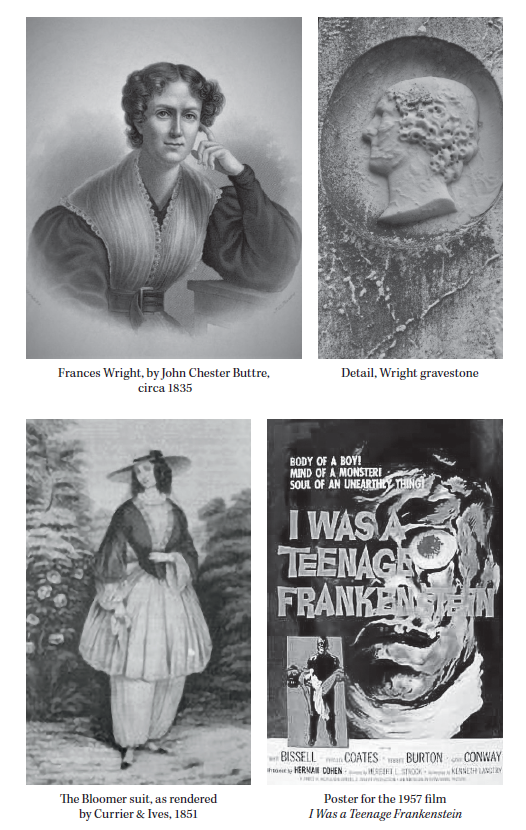
The one like-minded person who did decide to accompany Wright to Nashoba was Frances Trollope. She headed westward at age forty-eight in part because she was swayed by Fanny’s ardor for the New World and the cause of abolition, but also because she had creditors to dodge. She was a woman unaccustomed to privation, as might be indicated by her decision to rough it in the swamps of Tennessee with several of her children in tow, and with a brace of household servants. The dank discomforts of the transatlantic passage quickly made clear to Trollope that Wright had embroidered a bit in her descriptions of America, and conditions when they reached Nashoba would have disabused her of any remaining romantic notions. Food was scant, morale dismal. Trollope soon moved on to the bustling frontier city of Cincinnati and a career for a while as a museum impresario, and afterward as proprietor of the doomed and mismanaged Bazaar, a “queer, unique, crescented Babel” that was in essence the frst department store.
Fanny Wright hunkered in and doubled down, publishing a full-throated defense of Nashoba—on the voyage she read part of a draft aloud to (bafed?) sailors—that didn’t tamp down the controversy but embraced it. Then, back at New Harmony for July 4, she gave a stem-winding oration and began the career that would bring her most fame, or notoriety. One of the most controversial elements of her philosophy was her belief that sexuality was the “strongest and the noblest of human passions.” At New Harmony, she became the very first woman in America to espouse such ideas in a large, mixed crowd—a “promiscuous assembly,” as her detractors put it.
T he cultural backdrop in the late 1820s was explosive. One argument for abolition in the puritanical North, seldom made explicitly, held that its evil was tempting male slaveholders (including Jeferson, infamously) into a further outrage, the sexual license—today it would get a blunter, four-letter name—eventually to be known as “miscegenation.” This period marked, too, the peak flowering of a period of evangelical zeal and conversion, especially among women, and one element of the so-called Second Great Awakening was its appeal to emotion and openness to the supernatural. Decades before P. T. Barnum, Trollope would exploit the American susceptibility to hocus pocus in her wax-figure multimedia shows at Cincinnati’s Western Museum. The first, “The Invisible Girl,” featured her son Henry, spouting Latin and Greek gibberish, as the voice of the disembodied girl. When she created her Dante spectacle, “Infernal Regions,” Christians looking to scare themselves straight by visiting Trollope’s version of hell were so prone to freak out and maul the valuable mannequins that Trollope had the figures wired to give a nasty shock.
A decade or two later, in part thanks to Fanny Wright, another offshoot of the Second Great Awakening would be the women’s suffrage movement . . . but for now she was swimming, or failing, against a food-tide of disapproval. Wright’s first lecture tour had a more immediate backdrop, too: the bitter 1828 presidential race between incumbent John Quincy Adams and her old ally Andrew Jackson, a campaign in which lewd allegations against the candidates, and especially their wives, would get plenty of attention.
Whether the auditor was inclined to rage or approval, Wright’s style and stagecraft were galvanizing. Sometimes carrying notes (rarely consulted) and sometimes just with a copy of the Declaration of Independence, she usually appeared amid a phalanx of up to thirty women. She was tall and redheaded, and she developed a style of dress, including a loose bodice and pantaloons that stretched to the ankle, that would later get adopted and adapted by feminists like Amelia Bloomer and Elizabeth Cady Stanton . . . yes, atop her other iconoclasms, Fanny Wright was the first American woman to wear pants in public.
Like many outspoken women, Wright was ridiculed for being mannish, accused of being insufficiently or inauthentically female. Catharine Beecher, elder sister of Harriet Beecher Stowe, heard her speak in Cincinnati in 1829, and years later wrote:
Who can look without disgust and abhorrence upon such an one as Fanny Wright, with her great masculine person, her loud voice, her untasteful attire, going about unprotected, and feeling no need of protection, mingling with men in stormy debate, and standing up with bare-faced impudence, to lecture a public assembly . . . with brazen front and brawny arms, attacking all that is venerable and sacred in religion, and that is safe and wise in law, all that is pure and lovely in domestic virtue.
Perhaps the most colorful phrase here is “with brazen front and brawny arms,” and of course the overall tenor is vicious. But the clause that fascinates me is “going about unprotected, and feeling no need of protection.” Tose last six words aren’t required by logic, and rhetorically are an interruption. Am I wrong to see grudging awe beneath the abhorrence? Where, Beecher seems to be wondering, does this monster of confidence come by her surety?
Barely a decade earlier, another radical woman, putting the words in the mouth of a creature despised and disdained, had written: Beware, for I am fearless and therefore powerful. That woman had seen Wright off for America barely a year earlier, and had collected a lock of the firebrand's hair before she went.
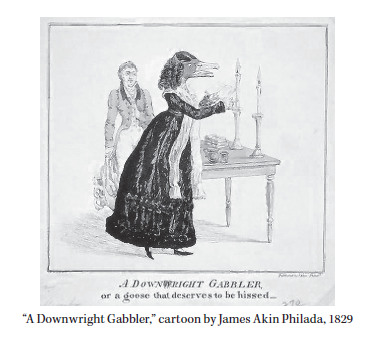
Wright’s appearances were mobbed, and sometimes worse than mobbed. But she was unfazeable. In New York she gave a series of six lectures, and people clamored in the streets to get in. In one case, when a saboteur cut off the gas line to the hall, Wright proceeded first in darkness and then by flickering candlelight. Later, she would brazen her way through a talk despite toxic smoke billowing from a turpentine barrel ignited by a protester; still later, she would press on even amid spraying window glass and the ricocheting stones that had broken it. Her fame and infamy grew. She was denounced as the Great Red Harlot, the Priestess of Beelzebub, the Whore of Babylon, a Downright Gabbler.
(A couple of side-notes about the cartoon illustrated here, which dates from her triumphant 1829 tour: Wright is depicted as somewhat less radical and terrifying than she must have seemed in reality—which makes one wonder whether this caricaturist hadn’t actually seen her, or whether he had and was trying, for the sake of visual or intellectual simplicity, to make the threat she posed seem more conventional and thus more easily dispatched. Fanny the Goose is wearing a dowdy, unfashionable dress; reading from a prepared text; and she’s alone on the stage except for a docile, overly polite man who is holding her traditional bonnet—and resting his hand inside his waistcoat, Napoleonically. The message seems clearly directed at men, who are failing to shout her down and give her the hissing she “deserves.”)
It was a heady moment for Wright, who left no idol unsmashed, no conventional wisdom unexploded. She gloried in wounding male virtue: Men, she said, “are incomprehensible animals . . . They walk about boasting of their wisdom, strength, and sovereignty, while they have not sense so much as to swallow an apple with the aid of an Eve to put it down their throats.” She had become a symbol of all things new and disruptive, and “Fanny Wrightism” became the bugbear of polite society. In 1830, the slate of candidates of the Working Men’s Party became known as the Fanny Wright ticket; they even won a seat in the New York state legislature.
Wright was not immune to delusions of grandeur. Around this time, her old companion and rival Trollope observed to Wright’s mentor the Marquis de Lafayette that “[Fanny] anticipates confidently the regeneration of the whole human race from her present exertions.” Is there envy in that? Perhaps. Sneering? Certainly—one can see the dry-ice chill billowing. But Trollope, by this point writing her own, more truculent book about America, also admired Wright’s stores of energy and optimism, and her rhetorical gifts. After one Cincinnati lecture, Trollope wrote:
I knew her extraordinary gift of eloquence, her almost unequaled command of words, and the wonderful power of her rich and thrilling voice. . . . [A]ll my expectations fell far short of the splendor, the brilliance, the overwhelming eloquence of this extraordinary orator. . . . Her tall and majestic figure, the deep and almost solemn expression in her eyes, the simple contour of her finely formed head, unadorned, excepting by its own natural ringlets; her garment of plain white muslin, which hung around her in folds that recalled the drapery of a Grecian statue, all contributed to produce an effect, unlike any thing I have ever seen before, or ever expect to see again.
That combination of affection and derision (brilliantly captured, by the way, in Edmund White’s 2003 novel Fanny, in which Frances Trollope narrates Fanny Wright’s story)[3] defined their relationship. One American value that Trollope understood, absorbed, and even advanced was the huckster spirit, and she had discovered both the liberation and the danger in feeling contempt for one’s customer. By this point, Trollope had the carnival barker’s cynicism toward rubes, but her friend—against all odds, and at enormous personal cost—resisted cynicism. Wright was, echoing another strand of the American character, a true believer. An entertainment like “Infernal Regions” required recognizing religious zeal and draining it of entertainment (the American way!). If the believer got zapped by a booby-trapped waxwork, that was the price for seeking comfort in hell. Meanwhile Fanny Wright mounted the dais day after day and mustered genuine rage, didn’t just rattle tin pans in the wings but hurled thunderbolts whose reality she believed in.
Wright wanted nothing less than to save America from error, to replace false righteousness with true. Her lectures were designed to ft into—but also to break from—the tradition of sermonizing. In her secular religion, churches would be supplanted by Halls of Science, but those halls would be not a repudiation of the religious impulse but a purer, better home for it.
In William Gass’s “Emerson and the Essay,” he writes that one leaves a Ralph Waldovian production—on the page or in person, the essence of the essay being performance—inspired, with one’s heart riding higher. But . . .
We have scarcely gotten home, our feet wet and chilly from the snow, or our chest asweat from the deep summer heat like a heavy coat we can’t remove, when our children’s sneezes greet us, skinned knees bleed after waiting all day to do so. Tere is the bellyache and the burned-out basement bulb, the stalled car and the incontinent cat. The windows frost, the toilets sweat, the body of our spouse is one cold shoulder, and the darkness of our bedroom is soon full of the fallen shadows of our failures. Now the quiet night light whispers to us: You are unloved— unlovely—you are old. Tese white sheets rehearse the corpse they will cover. None of our times change. We are the same age as our essayist. Wrinkles squeeze our eyes shut, and we slide into sleep like a sailor from beneath his national fag. Tomorrow our tumescence must be resumed. Tomorrow, Emerson realizes, he must again be a genius.[4]
To me this passage gets to the nub of Frances Trollope’s, and my, esteem for Fanny Wright. In Gass’s piece, all the frailties of the auditor apply as well to the lecturer. Mary Shelley saw this vulnerability in Wright and reported it in her letter to Robert Dale Owen. Tomorrow one must once again be a genius, and the price of that genius is a belief in the world’s perfectibility. Unless we can muster idealism, unless we can gin up a conviction that things really could and should be better, what’s the point? But the world throws up too many barriers against that belief for an intelligent person to hang on to it. Most days, if you’re paying any attention at all, you have to be a perfect idiot—idiot in its original sense of someone so enmeshed in her own head, her own circumstances, as to be paying no attention to external reality—to believe that the world cares what you think, or that you can make a difference. Over the coming years, Fanny Wright’s idealism would be taxed again and again, would waver and need resuscitation again and again.
One realizes, reluctantly, that the preceding paragraph has essentially the same narrative as the video for Bon Jovi’s “Wanted: Dead or Alive,” in which we see the hard-working hairband post-concert, drained. Tey may have seen a million faces and rocked them all, but there is always a tomorrow, containing new faces to be rocked. Believing that what you think or do is of world-altering importance is of course a delusion, but it’s a hopeful delusion, one that gives humanity more credit than it deserves rather than less. And that’s by far the more likable, though also the more mystifying, kind of delusion. But still, even for Fanny Wright or John Francis Bongiovi Jr., there comes the night, the doubt, the exhaustion, and the “white sheets rehearse the corpse they will cover,” and “every day it seems we’re wastin’ away.” The world is a colossal buzzkill.
Nashoba reached a breaking point in 1830, and Wright had no choice but to admit defeat. The president of Haiti had offered to help, so she chartered a boat and accompanied thirteen formerly enslaved persons and their eighteen children to western Hispaniola. After helping arrange housing and work for the refugees, Wright returned to New York amid renewed controversy; a newspaper editor accused her of profting (in the form of a sack of gold coins Haitian president Jean-Pierre Boyer had bestowed upon her for “expenses”) from what she’d touted as a moral obligation. Wright wrote a point-by-point refutation, but promptly disappeared from the limelight. She was pregnant, and knew that a child out of wedlock was exactly the scandal her detractors had been looking for. She returned to Europe, secretly married her baby-to-be's father (I would argue that there’s no hypocrisy in this: what makes a tyranny is its power to make one submit), and bore her child, a daughter she named Sylva. When a second child died in infancy, she would give Sylva that child’s birthdate to provide cover from rumor-mongering.
Fanny Wright spent the 1830s bouncing between the United States and Europe. Neither her marriage nor her domestic situation in Europe was happy. Te quiet, retired life wasn’t for her, not least because she had no patience for or skill in the things her culture considered properly motherly or huswifely. “And make my Soule thy holy Spoole to bee,” as Puritan poet Edward Taylor had urged in his hymn to submission? No thanks. Hapless Fanny and her querulous husband were often ill, and she felt isolated, beleaguered, bedraggled. She and her husband seldom lived together after the mid-1830s, and soon afterward came Fanny’s bitter estrangement from Sylva, which would haunt her later years.
In 1834, Wright traveled to London to lecture, but after the first date, attendance plummeted. Indifference was a phenomenon she’d never met with before. The next year she ventured back to the United States. When, after the race riots of 1836 in Cincinnati, she decided to speak and try to calm the waters, she discovered that no one much attended to the substance of what she said. Much as would happen to twentieth-century female icons from the movies—Mae West or Marilyn Monroe, say—her notoriety had hardened into caricature, except that she was pegged not as sexpot but as the Great Red Harlot: “a great awkward bungle of womanhood,” one 1830s reviewer wrote, “about six feet in longitude, with a face like a Fury, and her hair cropped like a convict.” Wright is one of the first examples of a distinctly American phenomenon: the prison-house of celebrity. To be known by the public is to be owned by it. If Britney Spears earns a PhD in astrophysics, it will enter her obituary only after the underwearless crotch-shot caught on film by a paparazzo, the new Mickey Mouse Club alongside Justin Timberlake, “Hit Me Baby One More Time.”
As Norman Mailer (hard to imagine a less likely ally for Wright!) put it in Armies of the Night, with typical vainglory but also insight, the celebrity lives in “the sarcophagus of his image”: “At night, in his sleep, he might dart out, and paint improvements on the sarcophagus. During the day, when he was helpless, newspapermen and other assorted bravos . . . would carve ugly pictures on the living tomb of his legend.”[5] Tis was Wright’s plight in the 1830s. Te public felt it had her number, so they lost interest. The country had pressing economic crises, too; the Panic of 1837 would ruin many and spark a recession that lasted eight years. Wright’s crowds grew scanter and sadder, and they seemed to be listening to a distant after-echo of her. She was a curiosity, an arena band now consigned to playing dive bars, and being urged to play only her hits, so that they could be simultaneously sung along to and ironized.[6]
Wright’s indomitability had always derived from her determination to persist in idealism despite all discouragement. Toward the end, though, she lost the ability to believe with any consistency the sentiment articulated by her fellow abolitionist Teodore Parker, then paraphrased a century later by Martin Luther King Jr. and forty years after that by Barack Obama: “Te arc [of the moral universe] is a long one, my eye reaches but little ways; I cannot calculate the curve and complete the figure by the experience of sight; I can divine it by conscience. And from what I see I am sure it bends towards justice.” Instead, Wright wrote, she now saw society as “a complicated system of errors.”
Wright’s health failed again and repeatedly in her final years. Her finances were strained. She went through a tempestuous divorce, then a bitter chancery suit that wouldn’t be resolved until after her death (here again she’d prove to be a trailblazer, becoming the first woman in Ohio to win protection of the assets with which she entered marriage against the predations of an ex). She spent a couple winters at Nashoba, attended by a hired carpenter and subsisting on crackers, eggs, scraps of potato, and the great old stories. In the winter of 1852, she slipped on icy steps outside her daughter’s house in Cincinnati, and after a long, anguished convalescence during which Sylva refused to visit her, she died on December 13, 1852. Her obituary would say little about the career that had won her such renown and such animosity.
Wright’s grave at Spring Grove bears the epitaph she wrote: “I have wedded the cause of human improvement, staked on it my fortune, my reputation and my life.” A bit surprisingly, it mentions, too, the lesser cause to whom she was wedded—though her married name is inscribed in a smaller font below. But the biggest surprise involves Sylva. She would remain embittered enough that a quarter-century later she would testify in Congress against women’s suffrage—and in doing so would pointedly invoke her mother’s name. She moved to Nashoba, transformed it into a private estate, raised her children there, died there. But Sylva too is here in Spring Grove, buried not with her father or with her husband but—together at last—with her mother. The side of Fanny Wright’s monument reads “Erected to her memory by her daughter Frances Sylva Phiquepal D’Arusmont/ Born April 14, 1832/ Thirty-two years/the widow of/ Dr. William Eugene Guthrie/ Died July 26, 1902/ and now lies beside her mother.”
_____________________
There's one more memorial to glance at before we go—the plaque erected
at the site of Nashoba (or, actually, not quite at the site) by the Tennessee Historical Commission. Mrs. Winner's Chicken & Biscuits is visible in the background. The marker includes one of the most artfully vague descriptions you'll ever see. Nashoba is described, first of all, as a “plantation”—a word familiar to aficionados of Dixie historical markers, and one that here isn’t
precisely wrong, but that seems spectacularly inapt. Wright is dubbed a “spinster heiress.” Why mention Wright’s marital status, and make her—a woman who would in fact (if not in an orthodox way) be married and with child just five years later, and who was barely thirty—a permanently sexless maiden aunt? Is it an attempt to account, to the chicken-craving passerby or history-seeking pilgrim, for the confluence of bored, alone, and affluent that can result, if you don’t watch out, in “sociological experiments”? The phrase has the tone of Catharine Beecher, who granted that people like Fanny Wright were intelligent, to be sure, skilled, talented . . . but they lacked “that fne mental balance called common sense” and were equipped, instead, with dangerous excesses of “enthusiasm.” How different, in effect, is that sentiment from the one enshrined on this marker in “and other advanced sociological experiments”? The tendentious vagueness of that sentence is a marvel.
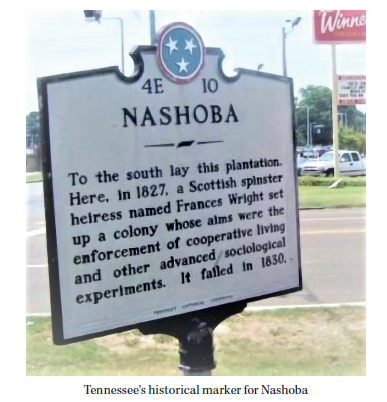
I haven’t been able to pinpoint the year the Nashoba marker was erected, but it seems to have been between 1949 and 1954. This was the height of Cold War paranoia about Soviet “enforcement of cooperative living,” so one may hear a whisper of opprobrium in that phrase. And is one wrong to see passive aggressiveness—even sarcasm—in the needless adjective “advanced”? “Why listen, lady!” says Flannery O’Connor’s Mr. Shiftlet in “The Life You Save May Be Your Own,” of 1955,[7] letting it be known that he doesn’t “mind sleeping in that car yonder” and so will accept the farm-handyman gig he’s been offered. “The monks of old slept in their coffins.” Replies the smug old lady, “Tey wasn’t as advanced as we are.”
But most shocking of all—shocking but not in the least surprising, a bit of rhetorical jujitsu the Jim Crow South excelled in—is the elision from the marker’s legend of slavery, indeed of race altogether, this on a marker put up between the Dixiecrat ticket and Brown v. Board. What kind of “advanced sociological experiments,” exactly? One won’t learn that here.
Sure, the white sheets rehearse the corpse they will cover. Our times, stubborn to the end, never change, and the world sucks, we too come to think, and the grounds for pride, and likewise the grounds for optimism, are soft enough to bog a buzzard’s shadow. But tomorrow morning someone’s going to have to get up and believe enough in the cause of human improvement to stake her life on it. For a time that genius, that Great Red Harlot, that hero and spinster heiress and great glorious bunglehood of woman, was Fanny Wright.
[1] I want to give thanks for and special acknowledgment to Kimberly Nichols’s essay “The Red Harlot of Liberty: The Rise and Fall of Frances Wright,” Newtopia Magazine, May 15, 2013 https://newtopiamagazine.wordpress.com/2013/05/15/the-red-harlot-of-liberty-the-riseand-fall-of-frances-wright/), which was an invaluable resource for this essay.
[2] Frances Wright, Views of society and manners in America; in a series of letters from that country to a friend in England, during the years 1818, 1819, and 1820 (New York, E. Bliss and E. White, 1821), 87.
[3] Edmund White, Fanny, a Fiction (New York: HarperCollins, 2003).
[4] William H. Gass, “Emerson and the Essay,” in Habitations of the Word (New York: Simon and Schuster, 1985).
[5] Norman Mailer, Armies of the Night (New York: New American Library, 1968), It may strain the reader’s sympathy—or smash it to smithereens—to recall that the public image Mailer is moaning about centered on the fact that, after a 1960 party, he stabbed his wife Adele Morales with a penknife. As I said, he is the strangest ally conceivable for Fanny Wright. And yet . . .
[6] I once had an undergraduate student write, memorably, about this phenomenon. The protagonist of his story was on spring break in South Padre, grooving to a live performance by Vanilla Ice, when sneering ironists started a fight. The protagonist threw in with his hero, and—as he held of the attackers in the club’s cramped kitchen (ironists are poor brawlers)—was thanked from the door by an escaping Mr. Ice, who sadly confused: “All I wanted . . . all I ever wanted was to rock the mic like a vandal.”
[7] Flannery O’Connor, “The Life You Save May Be Your Own,” in A Good Man Is Hard to Find (New York: Harcourt, Brace, 1955).